
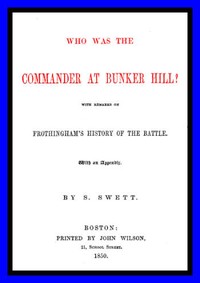
Who was the Commander at Bunker Hill?: With Remarks on Frothingham's History of the Battle
Written by Samuel Swett
Chaptra reads alongside you — AI insights, chapter breakdowns and reader discussions for every book. Join free
About this book
Reading guide
Themes, characters and key ideas in Who was the Commander at Bunker Hill?: With Remarks on Frothingham's History of the Battle, written by Chaptra AI.
- about 8 hours
- advanced
- Analytical
- Argumentative
- Historical
Samuel Swett's "Who was the Commander at Bunker Hill?" is a meticulous historical treatise challenging prevailing narratives regarding the command structure at the pivotal Revolutionary War battle. Primarily, Swett aims to firmly establish Colonel William Prescott as the de facto commander of the American forces, directly refuting or correcting interpretations, particularly those put forth by historian Richard Frothingham. The work delves into primary source analysis, eyewitness accounts, and logistical considerations to build a compelling case for Prescott's leadership, thereby contributing to a significant historiographical debate of the 19th century concerning one of America's foundational military engagements.
“"The object of this inquiry is to ascertain, from authentic sources, who was the commander of the American forces actually engaged in the Battle of Bunker Hill."”
Key themes
- Historical Interpretation and Revisionism
- The central theme of the book. Swett's entire purpose is to re-examine and revise a specific historical event (the command at Bunker Hill) based on his interpretation of evidence. It explores how historical narratives are constructed, debated, and potentially altered over time.
- The Nature of Command and Leadership in Battle
- Beyond the specific historical figures, the book implicitly explores what constitutes effective command in a chaotic battle scenario. Swett's argument for Prescott highlights qualities of direct presence, clear orders, and recognized authority, contrasting it with more ambiguous or distant leadership roles.
- The Role of Evidence and Proof in Historical Inquiry
- Swett's work is a masterclass in presenting and scrutinizing historical evidence. He demonstrates how primary sources are used, weighed, and interpreted, and how conflicting accounts must be reconciled or dismissed based on credibility and corroboration. This highlights the subjective yet rigorous nature of historical 'proof'.
Worth discussing
How does Swett's work exemplify 19th-century historiographical methods, and how do these compare to modern historical practices?
Chapter-by-chapter breakdowns, character arcs and the full thematic analysis come with a free account.
Discussions
No one has started one yet
Questions this book opens up
No discussions yet
Be the first to start a discussion about this book!
Sign up to start the discussionReviews
No reviews yet
Be the first to review this book!