
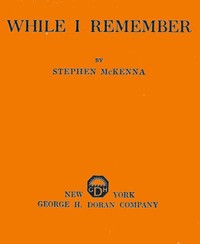
While I Remember
Written by Stephen McKenna
Chaptra reads alongside you — AI insights, chapter breakdowns and reader discussions for every book. Join free
About this book
Reading guide
Themes, characters and key ideas in While I Remember, written by Chaptra AI.
- about 8 hours
- intermediate
- Reflective
- Nostalgic
- Melancholy
Stephen McKenna's "While I Remember" is a poignant early 20th-century memoir reflecting on a vanished era, particularly the years leading up to World War I. The narrative traces McKenna's formative experiences at prestigious institutions like Westminster School and Oxford University, capturing the unique atmosphere, traditions, and intellectual currents that shaped his generation. It serves as an introspective journey, juxtaposing the innocence and certainties of pre-war youth with the profound societal and personal changes wrought by the Great War. Through a lens of nostalgia, McKenna explores themes of memory, the passage of time, and the indelible impact of historical cataclysms on individual lives and the collective consciousness of a nation.
“It was not merely a generation lost to war, but a world that vanished with them, leaving us to navigate the echoes.”
Key themes
- Memory and Nostalgia
- McKenna extensively explores the act of remembering, particularly the subjective and often bittersweet nature of recalling a past that is irrevocably lost. He delves into how personal memories interact with historical events, and how nostalgia, while comforting, can also highlight the profound sense of loss. The memoir itself is an exercise in preserving these memories against the erosion of time.
- The Impact of World War I
- While not a war narrative in the traditional sense, WWI is the pervasive, defining event that casts a long shadow over the entire memoir. McKenna analyzes its profound psychological, social, and political repercussions, particularly the loss of a generation and the subsequent disillusionment. The war serves as the ultimate catalyst for the 'end of an era' and the catalyst for his reflective journey.
- The End of an Era / Social and Political Change
- The memoir vividly portrays the transition from the Edwardian era's perceived stability and class structure to the tumultuous interwar period. McKenna highlights the societal norms, political beliefs, and cultural practices that defined his youth, then contrasts them with the radical transformations brought about by World War I, demonstrating how a whole way of life could vanish almost overnight.
Worth discussing
How does McKenna use memory and nostalgia to shape his narrative? Is his recollection entirely reliable, or is it colored by later events?
Chapter-by-chapter breakdowns, character arcs and the full thematic analysis come with a free account.
Discussions
No one has started one yet
Questions this book opens up
No discussions yet
Be the first to start a discussion about this book!
Sign up to start the discussionReviews
No reviews yet
Be the first to review this book!