
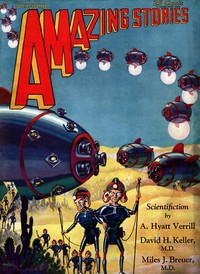
When the atoms failed
Written by John W. Campbell
Chaptra reads alongside you — AI insights, chapter breakdowns and reader discussions for every book. Join free
About this book
Reading guide
Themes, characters and key ideas in When the atoms failed, written by Chaptra AI.
- about 8 hours
- intermediate
- action-packed
- scientific
- adventurous
John W. Campbell, Jr.'s "When the Atoms Failed" thrusts readers into an early 20th-century cosmic conflict as Earth faces a devastating invasion from technologically superior Martians wielding atomic weaponry. The narrative follows brilliant scientist Stephen Waterson, who, alongside his friend David Gale and assistant Wright, invents the advanced spaceship "Terrestrian" to defend humanity. Their journey through space involves intense battles, the discovery of atomic energy's immense destructive power, and the development of counter-technologies. Ultimately, Waterson's ingenuity and scientific prowess determine the outcome of an epic interplanetary war, shaping the future of human-alien relations.
“"The atom, once split, unleashed not merely energy, but a new epoch of terror and triumph."”
Key themes
- Scientific Progress and Innovation
- This theme is central to the novel, positing that humanity's greatest strength lies in its capacity for scientific discovery and technological advancement. Stephen Waterson's ingenuity is the sole force capable of countering the Martian threat, highlighting science as both a weapon and a shield.
- Human Resilience and Survival
- Despite facing a vastly superior alien force and the threat of total annihilation, humanity demonstrates an indomitable will to survive. The narrative emphasizes courage, adaptation, and the collective effort to overcome an existential crisis.
- The Power and Peril of Atomic Energy
- Written before the atomic bomb, the novel speculates on the immense destructive potential of atomic energy, portraying it as both a catastrophic weapon in Martian hands and a potential tool for Earth's salvation. It explores the dual nature of scientific power.
Worth discussing
How does 'When the Atoms Failed' reflect early 20th-century anxieties and hopes about scientific progress and atomic energy?
Chapter-by-chapter breakdowns, character arcs and the full thematic analysis come with a free account.
Discussions
No one has started one yet
Questions this book opens up
No discussions yet
Be the first to start a discussion about this book!
Sign up to start the discussionReviews
No reviews yet
Be the first to review this book!