
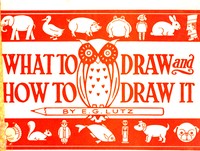
What to draw and how to draw it
Written by Edwin George Lutz
Chaptra reads alongside you — AI insights, chapter breakdowns and reader discussions for every book. Join free
About this book
Reading guide
Themes, characters and key ideas in What to draw and how to draw it, written by Chaptra AI.
- about 12 hours
- beginner
- Instructive
- Empowering
- Accessible
Edwin George Lutz's "What to Draw and How to Draw It" is a seminal early 20th-century instructional guide designed to demystify drawing for beginners, especially children. Through a systematic approach, the book breaks down complex subjects into simple, progressive steps, emphasizing the use of basic shapes and construction lines. It features hundreds of diagrams that gradually build forms, from initial outlines to detailed representations. Lutz's method aims to foster both technical skill and creative confidence, making the art of drawing accessible and engaging for aspiring young artists. The book stands as a foundational text in art education, promoting a structured yet empowering path to visual expression.
“Every complex form begins with simple shapes.”
Key themes
- Simplification and Deconstruction
- This theme is central to Lutz's methodology, emphasizing that any complex subject can be broken down into fundamental geometric shapes and lines. By deconstructing objects, the intimidating task of drawing becomes manageable and understandable for beginners. It teaches a way of seeing the world in terms of basic forms.
- Gradual Progression and Skill Building
- The book's entire structure is built upon the idea of incremental learning. Readers are guided through a carefully sequenced curriculum, moving from simple exercises to progressively more challenging ones. This gradual approach builds confidence and allows skills to develop organically, preventing overwhelm and fostering a sense of achievement with each step.
- Empowerment Through Accessibility
- Lutz's book demystifies drawing, presenting it not as an exclusive talent but as a teachable skill accessible to anyone, particularly children. By providing clear, actionable steps, it empowers individuals who might otherwise feel intimidated by art, fostering a belief in their own creative capabilities.
Worth discussing
How does Lutz's systematic approach to drawing compare to more free-form or intuitive art instruction methods?
Chapter-by-chapter breakdowns, character arcs and the full thematic analysis come with a free account.
Discussions
No one has started one yet
Questions this book opens up
No discussions yet
Be the first to start a discussion about this book!
Sign up to start the discussionReviews
No reviews yet
Be the first to review this book!