
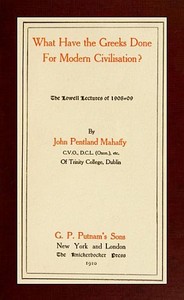
What Have the Greeks Done for Modern Civilisation?
Written by J. P. (John Pentland) Mahaffy
Chaptra reads alongside you — AI insights, chapter breakdowns and reader discussions for every book. Join free
About this book
Reading guide
Themes, characters and key ideas in What Have the Greeks Done for Modern Civilisation?, written by Chaptra AI.
- about 10 hours
- advanced
- informative
- analytical
- scholarly
J. P. Mahaffy's "What Have the Greeks Done for Modern Civilisation?" is a passionate series of lectures from the early 20th century, meticulously cataloging the profound and enduring influence of ancient Greek culture on contemporary society. The work systematically explores Greek contributions across philosophy, literature, art, science, and political thought, arguing that these foundational ideas are indispensable to understanding modern civilization. Mahaffy contends that despite a perceived decline in interest, particularly in America, the study of Greek culture remains crucial for intellectual development and societal progress. He ultimately advocates for a reform in classical education to re-emphasize its vital significance, underscoring the Greeks' role in shaping the very fabric of Western thought.
“"The greatest danger to modern civilization is the loss of its historical memory, especially its Greek foundations."”
Key themes
- The Enduring Legacy of Ancient Greece
- This is the central and pervasive theme, arguing that ancient Greek thought, art, and political structures are not merely historical relics but active, foundational elements of modern Western civilization. Mahaffy systematically demonstrates how Greek innovations in philosophy, literature, science, and governance continue to shape contemporary understanding and institutions.
- The Value of Classical Education
- Mahaffy passionately argues for the indispensable role of Greek studies in contemporary education. He contends that familiarity with classical texts and thought is crucial for developing critical thinking, a refined aesthetic sense, and a deep understanding of human nature and societal principles. He sees a decline in classical education as a threat to intellectual rigor and cultural depth.
- Cultural Continuity and Evolution
- This theme explores how Greek ideas were transmitted, adapted, and evolved through subsequent civilizations (Roman, Medieval, Renaissance) to reach modernity. Mahaffy illustrates that culture is not static but a continuous dialogue across millennia, with Greek thought serving as a primary interlocutor. He emphasizes the dynamic process of reception and reinterpretation.
Worth discussing
To what extent do Mahaffy's arguments for the relevance of Greek studies still hold true in the 21st century?
Chapter-by-chapter breakdowns, character arcs and the full thematic analysis come with a free account.
Discussions
No one has started one yet
Questions this book opens up
No discussions yet
Be the first to start a discussion about this book!
Sign up to start the discussionReviews
No reviews yet
Be the first to review this book!