
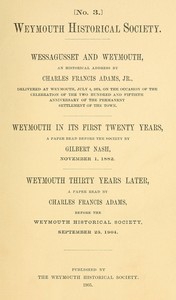
Wessagusset and Weymouth
Written by Charles Francis Adams,Gilbert Nash
Chaptra reads alongside you — AI insights, chapter breakdowns and reader discussions for every book. Join free
About this book
Reading guide
Themes, characters and key ideas in Wessagusset and Weymouth, written by Chaptra AI.
- about 12 hours
- advanced
- Historical
- Informative
- Challenging
Wessagusset and Weymouth by Charles Francis Adams, Jr. and Gilbert Nash is a late 19th-century historical account documenting the foundational struggles of two early Massachusetts Bay settlements. The work meticulously details the arduous challenges faced by European settlers in Weymouth and Wessagusset from their early 17th-century establishment, including severe winters, famine, and critical supply shortages. It explores the complex and often violent interactions between these nascent communities and the indigenous Native American populations. Through specific historical events and figures like Thomas Weston, the book portrays the dire circumstances and resilience required for survival, setting the stage for the eventual development and stability of the town amidst a new and unforgiving world.
“A passage detailing the severe shortage of provisions during the first winter.”
Key themes
- Struggle for Survival
- This theme is paramount, detailing the constant battle against a harsh environment, lack of provisions, disease, and the sheer difficulty of establishing a European-style settlement in an untamed wilderness. It encompasses the physical and psychological toll on the early settlers.
- Colonial Expansion and Its Consequences
- The book explores the practical realities and ethical complexities of European expansion into new territories. It details not only the ambitions of colonizers but also the unintended consequences, failures, and the profound impact on both the colonizers and the indigenous inhabitants.
- Conflict and Coexistence with Native Americans
- This theme examines the evolving relationship between the European settlers and the Native American tribes, which vacillated between periods of fragile coexistence, trade, and violent conflict. It underscores the cultural clash and competition for resources inherent in colonization.
Worth discussing
How does Adams's late 19th-century perspective shape the narrative of early colonial history, particularly concerning Native Americans?
Chapter-by-chapter breakdowns, character arcs and the full thematic analysis come with a free account.
Discussions
No one has started one yet
Questions this book opens up
No discussions yet
Be the first to start a discussion about this book!
Sign up to start the discussionReviews
No reviews yet
Be the first to review this book!