
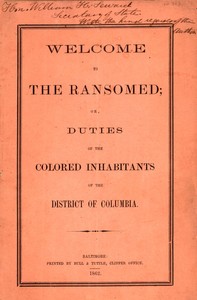
Welcome to the ransomed; or, Duties of the colored inhabitants of the District of Columbia
Written by Daniel Alexander Payne
Chaptra reads alongside you — AI insights, chapter breakdowns and reader discussions for every book. Join free
About this book
Reading guide
Themes, characters and key ideas in Welcome to the ransomed; or, Duties of the colored inhabitants of the District of Columbia, written by Chaptra AI.
- about 8 hours
- intermediate
- uplifting
- instructive
- hopeful
Daniel Alexander Payne's "Welcome to the Ransomed" is a powerful religious discourse from the early 1860s, serving as a guidance pamphlet for newly freed African Americans in Washington, D.C. Against the backdrop of the Civil War and Emancipation, Payne emphasizes the moral and spiritual duties accompanying newfound freedom. Structured as a sermon, the work implores its audience to embrace virtues like industriousness, prayer, education, and moral integrity as foundational to individual and community uplift. He articulates a vision where true liberation extends beyond physical emancipation to freedom from sin, urging diligence, financial prudence, and responsible child-rearing to build a unified, hopeful, and positively contributing society.
“Welcome, ye ransomed, to the glorious dawn of a new freedom, not merely from chains of iron, but from the shackles of sin!”
Key themes
- Emancipation and Responsibility
- Payne argues that freedom is not merely the absence of chains but a profound call to responsibility. He emphasizes that newfound liberty requires active engagement in moral, spiritual, and civic duties, challenging the audience to embrace self-governance and accountability as the true essence of emancipation.
- Spiritual Liberation and Moral Integrity
- Beyond physical emancipation, Payne stresses the paramount importance of spiritual freedom from sin and the cultivation of moral integrity. He posits that true liberation is incomplete without an inner transformation guided by divine principles, leading to virtuous conduct and a life free from moral degradation.
- Education and Self-Improvement
- Payne views education as a critical pillar for individual and communal advancement. He encourages both adults and children to pursue knowledge and self-improvement, recognizing that intellectual growth is essential for respectability, economic progress, and effective participation in society.
Worth discussing
How does Payne define 'true freedom,' and what are the implications of this definition for newly emancipated individuals?
Chapter-by-chapter breakdowns, character arcs and the full thematic analysis come with a free account.
Discussions
No one has started one yet
Questions this book opens up
No discussions yet
Be the first to start a discussion about this book!
Sign up to start the discussionReviews
No reviews yet
Be the first to review this book!