
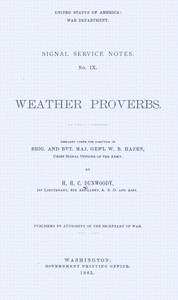
Weather proverbs
Written by H. H. C. (Henry Harrison Chase) Dunwoody
Chaptra reads alongside you — AI insights, chapter breakdowns and reader discussions for every book. Join free
About this book
Reading guide
Themes, characters and key ideas in Weather proverbs, written by Chaptra AI.
- about 10 hours
- intermediate
- informative
- observational
- historical
H. H. C. Dunwoody's "Weather Proverbs" is a late 19th-century scientific compilation that meticulously gathers and categorizes traditional weather lore. The book serves as a bridge between age-old folk wisdom, often derived from observing animals, plants, and atmospheric conditions, and the emerging field of modern meteorology. Dunwoody's work systematically presents these proverbs, frequently offering commentary on their scientific validity or observational basis, thus exploring humanity's enduring quest to understand and predict weather patterns. It highlights the collaborative effort to document these sayings while emphasizing that, despite their empirical roots, they are distinct from rigorous scientific measurement. This collection offers a fascinating look into the historical intersection of popular belief and scientific inquiry regarding the natural world.
“Many of these proverbs express observable patterns in the behavior of animals and environmental changes that can precede specific weather phenomena.”
Key themes
- Folklore vs. Science
- A core tension and exploration in the book is the relationship between traditional folk wisdom and emerging scientific methodology. Dunwoody diligently collects proverbs, often providing scientific commentary to validate, debunk, or contextualize them. This highlights the historical shift from anecdotal, orally transmitted knowledge to systematic, empirically measured scientific understanding, yet acknowledges the often-valid observational basis of folklore.
- The Wisdom of Nature and Observation
- This theme explores how humans have historically derived practical knowledge and predictive insights from keen observation of the natural world. The proverbs themselves are testaments to generations of watching animal behavior, plant cycles, and atmospheric shifts, highlighting an innate human capacity to identify patterns and infer future events from environmental cues.
- Humanity's Quest for Prediction and Control
- The very existence of weather proverbs speaks to humanity's deep-seated desire to predict and, by extension, prepare for or mitigate the impact of environmental changes. For agrarian and maritime societies, weather prediction was crucial for survival and livelihood. The proverbs represent an ancient form of risk assessment and planning, reflecting a fundamental human need to understand and adapt to an often unpredictable world.
Worth discussing
To what extent do you believe traditional weather proverbs still hold relevance in an age of advanced meteorological technology?
Chapter-by-chapter breakdowns, character arcs and the full thematic analysis come with a free account.
Discussions
No one has started one yet
Questions this book opens up
No discussions yet
Be the first to start a discussion about this book!
Sign up to start the discussionReviews
No reviews yet
Be the first to review this book!