
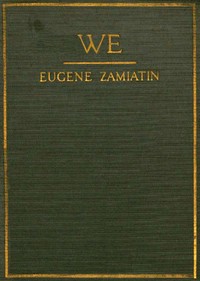
We
Written by Evgenii Ivanovich Zamiatin
Chaptra reads alongside you — AI insights, chapter breakdowns and reader discussions for every book. Join free
About this book
Reading guide
Themes, characters and key ideas in We, written by Chaptra AI.
- about 10 hours
- advanced
- dark
- dystopian
- philosophical
Evgenii Zamiatin's "We" is a seminal dystopian novel set in the United State, a future society where rigid mathematical logic and conformity suppress individual freedom and emotion. Narrated by D-503, a loyal mathematician and builder of the spaceship Integral, the story initially showcases his pride in the state's ordered existence. However, his encounter with the enigmatic and rebellious I-330 sparks a profound internal conflict, forcing him to question the values of his supposedly perfect society. As D-503 grapples with burgeoning feelings and the allure of the chaotic 'outside' world, the novel explores the timeless struggle between personal liberty and collective security. Ultimately, it culminates in a chilling depiction of the state's absolute control over human consciousness, cementing its legacy as a prophetic critique of totalitarianism.
“I am writing this - and I feel my cheeks burning. This must be similar to what a moderate glow is to a furnace. I am probably in a state of 'fever'.”
Key themes
- Individuality vs. Conformity
- This is the central conflict of the novel. The United State enforces absolute conformity, where citizens are 'Numbers,' wear identical clothing, follow rigid schedules, and suppress personal desires. D-503's journey is a struggle to reclaim his individuality, sparked by his connection with I-330, who embodies rebellion against this uniformity. The novel explores the psychological toll of conformity and the inherent human drive for unique identity.
- Freedom vs. Security
- The United State offers its citizens absolute security, guaranteed sustenance, and freedom from fear or uncertainty, but at the cost of all personal freedoms. The novel questions whether such a trade-off is desirable or sustainable, contrasting the 'happy' but enslaved Numbers with the 'wild' and free but potentially dangerous 'outside' world. It examines the seductive nature of totalitarian promises of order.
- Reason vs. Emotion
- The United State is founded on the principle of pure mathematical reason, viewing emotions as irrational, chaotic, and dangerous. D-503, a mathematician, initially champions this view, but his interactions with I-330 awaken his 'soul' and introduce him to the confusing, powerful world of feelings. The novel explores the inherent human duality between logic and passion, suggesting that a life devoid of emotion is incomplete and dehumanizing.
Worth discussing
How does Zamiatin's use of mathematical language and imagery contribute to the novel's themes?
Chapter-by-chapter breakdowns, character arcs and the full thematic analysis come with a free account.
Discussions
No one has started one yet
Questions this book opens up
No discussions yet
Be the first to start a discussion about this book!
Sign up to start the discussionReviews
No reviews yet
Be the first to review this book!