
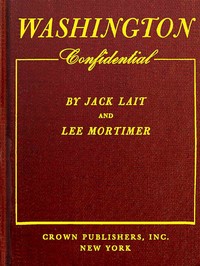
Washington Confidential
Written by Jack Lait,Lee Mortimer
Chaptra reads alongside you — AI insights, chapter breakdowns and reader discussions for every book. Join free
About this book
Reading guide
Themes, characters and key ideas in Washington Confidential, written by Chaptra AI.
- about 8 hours
- intermediate
- acerbic
- cynical
- revealing
"Washington Confidential" by Jack Lait and Lee Mortimer is a scathing journalistic exposé from the early 1950s that strips away the veneer of respectability from the nation's capital. The book presents Washington D.C. not as a pristine seat of power, but as a hotbed of corruption, vice, and moral decay. Through an acerbic and often satirical lens, the authors delve into the city's underbelly, revealing a pervasive culture of gambling, prostitution, political graft, and bureaucratic excess. It challenges the idealized image of governance by exposing the stark contradictions between architectural grandeur and the widespread dubious activities of its inhabitants, from high-ranking officials to ordinary government employees. Ultimately, the book serves as a controversial time capsule, documenting the perceived moral failings of a powerful city in a post-war era.
“"Washington is a city of paradoxes, where the marble gleams but the foundations are built on shifting sands of vice."”
Key themes
- Corruption and Hypocrisy
- This is the central pillar of the book. Lait and Mortimer relentlessly expose the widespread corruption, from petty graft to large-scale influence peddling, that they claim permeates Washington D.C. Hand-in-hand with corruption is hypocrisy, as public figures who advocate for moral uprightness are revealed to be engaging in private vices. The theme highlights the stark contrast between the city's official image and its sordid reality.
- The Dual Nature of Power
- The book examines how the immense power concentrated in Washington D.C. can be both a force for governance and a catalyst for moral decay. It suggests that power, when unchecked or combined with human weakness, can lead to arrogance, entitlement, and the belief that one is above the law or moral scrutiny. This theme explores the corrupting influence of power on individuals and institutions.
- Urban Decay / Moral Decline
- While not focusing on physical decay, the book vividly portrays a moral decline within the urban landscape of Washington D.C. It argues that the city's status as a capital does not elevate its inhabitants morally; rather, it attracts and concentrates human failings. This theme explores the idea that a city, despite its grand architecture, can harbor a pervasive sense of moral erosion and societal malaise.
Worth discussing
To what extent do Lait and Mortimer's observations about Washington D.C. in the 1950s resonate with perceptions of political capitals today?
Chapter-by-chapter breakdowns, character arcs and the full thematic analysis come with a free account.
Discussions
No one has started one yet
Questions this book opens up
No discussions yet
Be the first to start a discussion about this book!
Sign up to start the discussionReviews
No reviews yet
Be the first to review this book!