
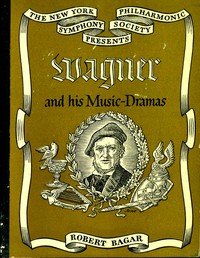
Wagner and His Music-Dramas
Written by Robert C. Bagar
Chaptra reads alongside you — AI insights, chapter breakdowns and reader discussions for every book. Join free
About this book
Reading guide
Themes, characters and key ideas in Wagner and His Music-Dramas, written by Chaptra AI.
- about 8 hours
- intermediate
- informative
- scholarly
- appreciative
Robert C. Bagar's mid-20th-century book, "Wagner and His Music-Dramas," offers a comprehensive analysis of Richard Wagner's revolutionary operatic works, including "Der Ring des Nibelungen," "Tristan und Isolde," and "Die Meistersinger von Nürnberg." It serves as both a detailed guide and an appreciation, exploring the philosophical underpinnings, musical innovations, and historical context of Wagner's unique style. Bagar delves into Wagner's life, tracing his struggles, influences, and artistic evolution, while also illuminating the central motifs and narrative arcs of his masterpieces. The book provides a nuanced understanding by juxtaposing Wagner's lofty artistic ideals with the complexities of his personal life, aiming to engage both dedicated enthusiasts and casual listeners.
“Wagner's genius lay not merely in his musical innovation, but in his audacious vision of the Gesamtkunstwerk, a total art form where music, drama, poetry, and stagecraft coalesced into an unprecedented unity.”
Key themes
- The Gesamtkunstwerk (Total Work of Art)
- Bagar extensively analyzes Wagner's groundbreaking concept of the 'Gesamtkunstwerk,' where music, poetry, drama, and stagecraft are meticulously unified into a single, cohesive, and immersive artistic expression. The book explores how Wagner sought to transcend traditional operatic forms, breaking down boundaries between art forms to create a more profound and total sensory experience for the audience.
- The Interplay of Life and Art
- Bagar examines how Wagner's tumultuous personal life—his struggles, exiles, relationships, political convictions, and philosophical readings—directly influenced the themes, emotional depth, and dramatic structures of his music-dramas. This theme explores the biographical underpinnings of his creative output, revealing how his lived experiences were transmuted into his artistic expressions.
- Musical Innovation and the Leitmotif System
- Bagar meticulously details Wagner's revolutionary contributions to music, particularly his development and sophisticated use of the leitmotif system. This theme explores how these recurring musical phrases serve as psychological signposts, identifying characters, objects, emotions, or abstract ideas, thereby guiding the audience through complex narratives and profound psychological states within his music-dramas.
Worth discussing
How does Bagar balance analysis of Wagner's music with discussion of his controversial personal life, and how effective is this approach?
Chapter-by-chapter breakdowns, character arcs and the full thematic analysis come with a free account.
Discussions
No one has started one yet
Questions this book opens up
No discussions yet
Be the first to start a discussion about this book!
Sign up to start the discussionReviews
No reviews yet
Be the first to review this book!