
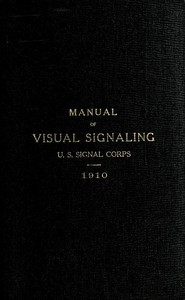
Visual Signaling
Written by United States. Army. Signal Corps
Chaptra reads alongside you — AI insights, chapter breakdowns and reader discussions for every book. Join free
About this book
Read it with a club
Small groups reading the same books and talking as they go.


News
- 4 members
- 1,813 discussions
- Active Sep 11
Read Visual Signaling alongside people who are reading it too.
Also here: News Bulletin, Just Joking....
Chaptra Prime — paid clubs, every club feature, and unlimited reading support, for $5 a month or $60 once.
See PrimeReading guide
Themes, characters and key ideas in Visual Signaling, written by Chaptra AI.
- about 8 hours
- intermediate
- Informative
- Instructive
- Authoritative
"Visual Signaling" by the United States Army Signal Corps is an early 20th-century military manual that comprehensively details the theory, equipment, and practical application of various visual communication methods. The work systematically covers techniques such as flags, heliographs, lanterns, rockets, and semaphores, alongside their operational protocols. It opens with an assertion of visual signaling's enduring importance, even amidst emerging electrical communication, highlighting its critical role when other technologies fail. The manual underscores the necessity for highly trained personnel and specialized equipment to ensure effective and reliable communication during military operations, serving as a foundational guide for the Signal Corps.
“The enduring significance of visual signaling despite advancements in electrical communication technology.”
Key themes
- Reliability and Redundancy in Communication
- This theme underscores the critical importance of having multiple, diverse communication channels, especially in military operations where primary systems might fail. The manual explicitly states that visual methods remain vital when electrical communication is ineffective, emphasizing the strategic necessity of robust backup systems.
- Discipline and Standardization
- The manual implicitly highlights the necessity of strict discipline and adherence to standardized protocols for effective military communication. Clear, unambiguous signals are paramount to prevent misinterpretation, which could have dire consequences in a military context. This requires rigorous training and uniform procedures.
- Adaptability and Resourcefulness
- The manual demonstrates the Army's need for adaptability by providing methods that can be utilized in various environmental conditions (day/night) and tactical situations. It showcases resourcefulness in leveraging simple, readily available means (light, flags) to achieve complex communication goals when high-tech solutions are unavailable or impractical.
Worth discussing
How does the manual's emphasis on visual signaling reflect the technological landscape and military doctrines of the early 20th century?
Chapter-by-chapter breakdowns, character arcs and the full thematic analysis come with a free account.
Discussions
No one has started one yet
Questions this book opens up
No discussions yet
Be the first to start a discussion about this book!
Sign up to start the discussionReviews
No reviews yet
Be the first to review this book!