
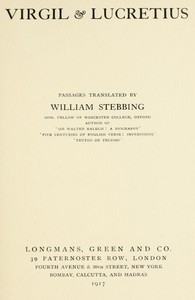
Virgil & Lucretius: Passages translated by William Stebbing
Written by Virgil,Titus Lucretius Carus
Chaptra reads alongside you — AI insights, chapter breakdowns and reader discussions for every book. Join free
About this book
Reading guide
Themes, characters and key ideas in Virgil & Lucretius: Passages translated by William Stebbing, written by Chaptra AI.
- about 8 hours
- advanced
- tragic
- philosophical
- reflective
This collection, "Virgil & Lucretius," translated by William Stebbing, presents a curated selection of classical poetic passages from two foundational Roman authors. It masterfully juxtaposes Virgil's mythological narratives, notably the poignant tale of Orpheus and Eurydice, with Lucretius's profound philosophical musings on the nature of existence. Through these works, the compilation explores universal themes such as love, loss, the beauty of nature, and the human struggle against mortality. The book offers readers a rich tapestry of vivid imagery and deep introspection, celebrating both the emotional depth of human experience and the intellectual pursuit of understanding the cosmos. It serves as a testament to the enduring power and relevance of classical literature in exploring life's most fundamental questions.
“No love, no song, no life could ever mend the broken vow, the tragic, sudden end.”
Key themes
- Love and Loss
- This theme is powerfully explored through the myth of Orpheus and Eurydice. It delves into the depth of romantic love, the devastating impact of grief, and the lengths to which one will go to reclaim a lost beloved. It also touches upon the fragility of life and the finality of death, highlighting the psychological toll of profound sorrow.
- The Human Condition and Mortality
- Both authors, though through different lenses, confront the fundamental aspects of human existence: our desires, fears, and inevitable mortality. Virgil illustrates this through tragic narrative, while Lucretius offers a philosophical framework, emphasizing life's ephemeral nature, the absence of an afterlife, and the pursuit of tranquility in the face of death.
- Nature and the Cosmos
- This theme explores humanity's relationship with the natural world and the larger universe. Virgil often uses pastoral settings to evoke beauty and peace, sometimes disrupted by tragedy. Lucretius systematically analyzes nature through his atomistic philosophy, explaining natural phenomena and the structure of the cosmos, reducing divine intervention and emphasizing natural laws.
Worth discussing
How do Virgil's mythological narratives and Lucretius's philosophical arguments complement or contrast each other in exploring the human condition?
Chapter-by-chapter breakdowns, character arcs and the full thematic analysis come with a free account.
Discussions
No one has started one yet
Questions this book opens up
No discussions yet
Be the first to start a discussion about this book!
Sign up to start the discussionReviews
No reviews yet
Be the first to review this book!