
Chaptra

The AI reading companion for people who take books seriously

AI insights, chapter breakdowns, community discussions — all in one place.

Join free
Book0 • 300+ pages • 5+ hours reading time

Views of nature: or Contemplations on the sublime phenomena of creation: with scientific illustrations

4.5/5
273 readers on Chaptra have this book

About this book

"Views of Nature: or Contemplations on the Sublime Phenomena of Creation" by Alexander von Humboldt is a scientific publication written in the mid-19th century. This work focuses on the author's reflections and observations concerning the beauty and complexity of nature, exploring various natural phenomena and their interconnections with human existence. Humboldt's intention is to merge aesthetic appreciation with scientific knowledge, offering readers both enjoyment and insight into the natural world. The opening of the book features Humboldt’s lyrical descriptions of vast landscapes, specifically focusing on the steppes and deserts of South America. It vividly contrasts the rich organic life of tropical regions with the barrenness of the plains, showcasing the feelings of awe and contemplation that arise in the face of such diverse natural environments. He introduces the geographic and climatic conditions influencing these areas, highlighting the adaptive strategies of both flora and fauna. Through detailed observations, Humboldt captures the dynamic relationship between nature and human experience, setting the stage for the deeper scientific discussions and illustrations that follow in the work.
Language
English
Publisher
Project Gutenberg
Release date
Unknown
Downloads
1.1K

More by Alexander von Humboldt

Browse all books by this author
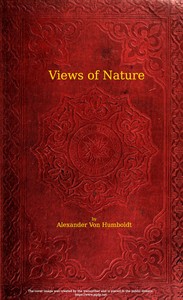
Cover of Views of nature: or Contemplations on the sublime phenomena of creation: with scientific illustrations

Click "Read now" to open in our Reader with AI features.

Community Discussions

Join the conversation about this book

Discussions

0 discussions

Join

No discussions yet

Be the first to start a discussion about this book!

Sign up to start the discussion

AI-Powered Insights

A clearer way to understand Views of nature: or Contemplations on the sublime phenomena of creation: with scientific illustrations through themes, characters, and key ideas

This reading guide highlights what stands out in Views of nature: or Contemplations on the sublime phenomena of creation: with scientific illustrations through 4 core themes, 1 character profile. It is meant to help readers decide whether the book fits their taste and deepen the reading once they begin.

AI Reading GuidePreview

About this book

A quick AI guide to “Views of nature: or Contemplations on the sublime phenomena of creation: with scientific illustrations

Get the shape of the book before you commit: what it is about, what mood it carries, and what ideas readers tend to stay with afterward.

~12h readadvancedPhilosophicalContemplativeAwe-inspiring

What the book is doing

Alexander von Humboldt's "Views of Nature" is a seminal mid-19th-century scientific publication that masterfully blends rigorous scientific observation with profound aesthetic appreciation of the natural world. Through lyrical prose, Humboldt explores diverse phenomena, from the vast steppes of South America to the intricate life of tropical regions, highlighting the interconnectedness of all creation. The work serves as a testament to the beauty and complexity of nature, aiming to offer readers both scientific insight and a deep sense of awe. It emphasizes the dynamic relationship between natural environments and human experience, laying foundational ideas for modern ecology and environmental thought. Humboldt's unique approach bridges the gap between scientific inquiry and philosophical contemplation, inviting readers to perceive nature not merely as a subject of study but as a source of sublime wonder.

Key Themes

Interconnectedness of Nature

This is the foundational theme, wherein Humboldt meticulously demonstrates that all natural phenomena—geological formations, climate, plant life, animal species, and even human cultures—are inextricably linked. He argues against viewing nature as a collection of isolated parts, instead presenting it as a dynamic, unified system where changes in one element ripple through the entire web.

The Sublime and Aesthetic Appreciation of Nature

Humboldt consistently emphasizes the awe-inspiring beauty and grandeur of the natural world, drawing from the Romantic concept of the sublime. He describes landscapes in vivid, emotional language, aiming to evoke feelings of wonder, reverence, and even a sense of human smallness in the face of nature's vastness and power. This theme suggests that nature offers not just scientific knowledge but also profound spiritual and emotional fulfillment.

A line worth noting
Nature is a living whole, where every part is connected to every other part.
A good discussion starter

How does Humboldt blend scientific observation with aesthetic appreciation, and what is the effect of this synthesis on the reader?

Unlock the full reading guide

See chapter-by-chapter takeaways, deeper character arcs, and a fuller literary analysis built around this book.

Unlock full AI analysis for “Views of nature: or Contemplations on the sublime phenomena of creation: with scientific illustrations

Chapter breakdowns, character deep-dives, and thematic analysis — all in one place.

Reader Reviews

See what others are saying

Reviews

Overall Rating

4.5
2280 ratings

Based on community ratings

No reviews yet

Be the first to review this book!

Readers Also Enjoyed

Discover more books similar to Views of nature: or Contemplations on the sublime phenomena of creation: with scientific illustrations