
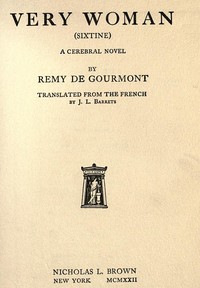
Very woman (Sixtine) : $b a cerebral novel
Written by Remy de Gourmont
Chaptra reads alongside you — AI insights, chapter breakdowns and reader discussions for every book. Join free
About this book
Reading guide
Themes, characters and key ideas in Very woman (Sixtine) : $b a cerebral novel, written by Chaptra AI.
- about 8 hours
- advanced
- Introspective
- Philosophical
- Romantic
Remy de Gourmont's "Very Woman (Sixtine): A Cerebral Novel" is an early 20th-century work of fiction that meticulously dissects the intricate intellectual and emotional dance between a sophisticated widow, Sixtine Magne, and a discerning man of letters, Hubert d'Entragues. Their relationship unfolds primarily through a series of philosophical discussions and clever repartees, exploring the profound nuances of desire, personal identity, and the complexities of human connection. Set against a backdrop rich with literary and existential contemplation, the novel's opening scene beneath ancient fir trees establishes a tone of intellectual flirtation and deep introspection. As their conversations delve into the nature of emotion, truth, and past experiences, the narrative lays a foundation for a rigorous examination of the dualities inherent in love and the cerebral pursuit of understanding another's soul.
“Is not all desire, at its core, a yearning for the unattainable truth of another's soul?”
Key themes
- Desire and Love
- The novel meticulously explores the multifaceted nature of desire and love, moving beyond simplistic romantic notions to dissect their cerebral, emotional, and existential dimensions. It examines how desire is intertwined with intellectual curiosity, the pursuit of understanding, and the complexities of human connection. Love is portrayed not merely as a feeling, but as a challenging intellectual and emotional negotiation between two complex individuals.
- Identity and Self-discovery
- Through the characters' introspective musings and their interactions, the novel delves into how individuals construct and perceive their own identities, and how these identities are challenged and redefined within the context of a relationship. Both Sixtine and Hubert engage in a process of self-discovery, prompted by their intellectual and emotional engagement with each other, forcing them to confront their pasts and their internal complexities.
- Intellect vs. Emotion
- A central tension in the novel is the interplay and often conflict between intellectual understanding and raw emotional experience. As a 'cerebral novel,' it posits that the mind can be both a tool for navigating emotions and a barrier to their full expression. The characters constantly analyze their feelings, questioning whether true connection is achieved through rational thought or intuitive emotional response.
Worth discussing
How does the novel define 'cerebral love' in contrast to other forms of affection? Is it sustainable or ultimately limiting?
Chapter-by-chapter breakdowns, character arcs and the full thematic analysis come with a free account.
Discussions
No one has started one yet
Questions this book opens up
No discussions yet
Be the first to start a discussion about this book!
Sign up to start the discussionReviews
No reviews yet
Be the first to review this book!