
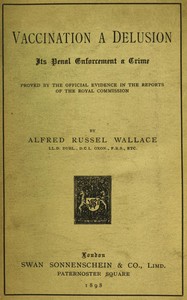
Vaccination a Delusion: Its Penal Enforcement a Crime: Proved by the Official Evidence in the Reports of the Royal Commission
Written by Alfred Russel Wallace
Chaptra reads alongside you — AI insights, chapter breakdowns and reader discussions for every book. Join free
About this book
Reading guide
Themes, characters and key ideas in Vaccination a Delusion: Its Penal Enforcement a Crime: Proved by the Official Evidence in the Reports of the Royal Commission, written by Chaptra AI.
- about 10 hours
- advanced
- critical
- confrontational
- analytical
Alfred Russel Wallace's "Vaccination a Delusion: Its Penal Enforcement a Crime" is a late 19th-century polemic vigorously challenging the scientific efficacy and ethical legitimacy of compulsory vaccination laws. Wallace, a renowned naturalist, meticulously scrutinizes official reports and statistics, arguing that data has been manipulated to conceal vaccination's alleged ineffectiveness and harms. He contends that improved sanitation, not vaccination, is responsible for declining disease rates, positioning the mandatory practice as a violation of personal liberty and an actual threat to public health. The book serves as a foundational text in the historical anti-vaccination movement, urging Parliament to abolish coercive medical interventions based on what Wallace perceives as flawed science.
“I propose to submit to Parliament and to the public a brief summary of the official evidence, which, when properly tabulated and studied, proves Vaccination to be a delusion; its penal enforcement a crime.”
Key themes
- Scientific Integrity and Data Interpretation
- Wallace's central argument hinges on his re-evaluation of official statistics and reports, accusing the Royal Commission and medical establishment of manipulating or misinterpreting data to support a pro-vaccination agenda. This theme explores the challenges of objective scientific inquiry, the potential for bias, and the responsibility of scientists and policymakers to present evidence truthfully.
- Personal Liberty vs. State Authority
- A core ethical and political theme is the conflict between individual autonomy and the coercive power of the state, particularly concerning health mandates. Wallace frames compulsory vaccination as a profound violation of personal liberty, equating its 'penal enforcement' with a 'crime.' He advocates for the right of individuals to choose their medical treatments without governmental coercion.
- Public Health and Environmental Determinism
- Wallace argues that improvements in public health and the decline of infectious diseases are primarily attributable to better sanitation, hygiene, and living conditions, rather than vaccination. This theme highlights a historical debate about the most effective strategies for disease prevention and challenges the prevailing medical focus on individual inoculation.
Worth discussing
How does Wallace's background as a naturalist influence his approach to public health and epidemiology?
Chapter-by-chapter breakdowns, character arcs and the full thematic analysis come with a free account.
Discussions
No one has started one yet
Questions this book opens up
No discussions yet
Be the first to start a discussion about this book!
Sign up to start the discussionReviews
No reviews yet
Be the first to review this book!