
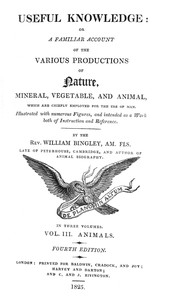
Useful Knowledge: Volume 3. Animals: Or, a familiar account of the various productions of nature
Written by William Bingley
Chaptra reads alongside you — AI insights, chapter breakdowns and reader discussions for every book. Join free
About this book
Reading guide
Themes, characters and key ideas in Useful Knowledge: Volume 3. Animals: Or, a familiar account of the various productions of nature, written by Chaptra AI.
- about 12 hours
- intermediate
- Informative
- Scientific
- Didactic
William Bingley's "Useful Knowledge: Volume 3. Animals" is a foundational early 19th-century scientific text dedicated to the animal kingdom. As part of a larger encyclopedic work, this volume systematically introduces zoology, presenting a detailed classification of animals into classes such as Mammalia, Birds, Amphibia, Fishes, Insects, and Worms. The book not only outlines the defining characteristics of each group and their internal orders but also emphasizes the practical utility of various species to human life, ranging from sustenance to materials for industry. It serves as both an informative guide for burgeoning naturalists and a comprehensive reference, reflecting the scientific understanding and anthropocentric worldview of its era.
“"The vast and diversified family of animals presents to the discerning eye a spectacle of order and utility, each creature contributing to the grand design of nature and the sustenance of mankind."”
Key themes
- Order and Classification in Nature
- This theme is central to the book, reflecting the Enlightenment-era drive to categorize and systematize all knowledge. Bingley meticulously organizes the animal kingdom into classes, orders, and species, emphasizing the scientific method of observation and logical grouping. This reflects a belief in a rational, ordered universe, often seen as a reflection of divine design.
- Utility of Animals to Humanity
- Explicitly stated in the title, this theme underscores the practical and economic value of animals to human society. Bingley details how various species serve as food sources, provide materials for clothing (wool, leather), contribute to tools, or offer labor. This anthropocentric perspective was prevalent in the early 19th century, viewing nature largely through the lens of human benefit and resource exploitation.
- Humanity's Place in the Natural World
- The book implicitly positions humanity as the primary observer, classifier, and beneficiary of the natural world. While marveling at nature's complexity, the narrative maintains a perspective of human dominion and intellectual superiority, tasked with understanding and managing the animal kingdom. This reflects a pre-ecological understanding where humans were often seen as separate from, rather than integrated within, natural ecosystems.
Worth discussing
How does Bingley's classification system compare to modern zoological taxonomy, and what does this reveal about the evolution of scientific thought?
Chapter-by-chapter breakdowns, character arcs and the full thematic analysis come with a free account.
Discussions
No one has started one yet
Questions this book opens up
No discussions yet
Be the first to start a discussion about this book!
Sign up to start the discussionReviews
No reviews yet
Be the first to review this book!