
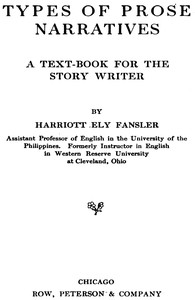
Types of Prose Narratives: A Text-Book for the Story Writer
Written by Harriott Ely Fansler
Chaptra reads alongside you — AI insights, chapter breakdowns and reader discussions for every book. Join free
About this book
Reading guide
Themes, characters and key ideas in Types of Prose Narratives: A Text-Book for the Story Writer, written by Chaptra AI.
- about 18 hours
- intermediate
- Instructive
- Academic
- Historical
Harriott Ely Fansler's "Types of Prose Narratives: A Text-Book for the Story Writer" is an early 20th-century pedagogical work designed to instruct aspiring authors in the art and craft of storytelling. The book posits that narrative is fundamental to human understanding and creation, emphasizing that effective writing is a cultivated skill, not an innate talent. Fansler systematically explores various narrative forms, from ancient myths to modern fiction, detailing their structures, characteristics, and historical evolution. By providing a comprehensive historical context alongside practical guidance, the text aims to equip writers with a deep appreciation for the traditions of storytelling, thereby fostering confidence and inspiration for their own original work.
“Narratives are essential to both our understanding of literature and our capacity to create.”
Key themes
- The Craft of Storytelling
- This theme explores the idea that writing is not merely an intuitive act but a learned skill requiring systematic study, practice, and an understanding of established forms and techniques. Fansler emphasizes the deliberate construction of narrative elements like plot, character, and structure.
- Historical Evolution of Narrative
- Fansler underscores that current narrative forms are products of a long evolutionary history, rooted in ancient traditions like myths and legends. Understanding this lineage provides context, inspiration, and a deeper appreciation for the development of literary forms.
- Pedagogy of Writing
- The book itself embodies this theme, functioning as a guide for aspiring writers. It explores the principles and methods by which writing can be taught and learned, emphasizing a systematic, analytical, and practice-oriented approach to skill development.
Worth discussing
How does Fansler's early 20th-century perspective on narrative craft compare with contemporary approaches to creative writing?
Chapter-by-chapter breakdowns, character arcs and the full thematic analysis come with a free account.
Discussions
No one has started one yet
Questions this book opens up
No discussions yet
Be the first to start a discussion about this book!
Sign up to start the discussionReviews
No reviews yet
Be the first to review this book!