
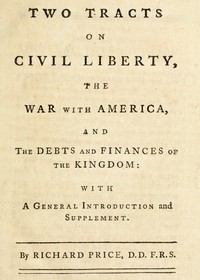
Two Tracts on Civil Liberty, the War with America, and the Debts and Finances of the Kingdom: With a General Introduction and Supplement
Written by Richard Price
Chaptra reads alongside you — AI insights, chapter breakdowns and reader discussions for every book. Join free
About this book
Reading guide
Themes, characters and key ideas in Two Tracts on Civil Liberty, the War with America, and the Debts and Finances of the Kingdom: With a General Introduction and Supplement, written by Chaptra AI.
- about 8 hours
- advanced
- Intellectual
- Analytical
- Urgent
Richard Price's "Two Tracts on Civil Liberty, the War with America, and the Debts and Finances of the Kingdom" is a powerful 18th-century treatise advocating for fundamental civil liberties and condemning Britain's policies towards its American colonies. Price meticulously argues that legitimate government derives from the consent of the governed, asserting the colonies' right to self-governance against parliamentary overreach. He intertwines philosophical principles of freedom and equality with pragmatic warnings about the economic perils of prolonged war and escalating national debt. The work serves as both a profound statement on political philosophy and a prescient critique of contemporary British imperial and financial practices, resonating deeply with the spirit of the American Revolution.
“Civil liberty is the power of a state to govern itself by its own laws, and to be subject to no other power than its own.”
Key themes
- Civil Liberty and Self-Governance
- Price meticulously defines and advocates for civil liberty as the cornerstone of legitimate government. He argues that true liberty involves the power of a community to govern itself through its own laws and representatives, asserting that any external imposition of authority without consent constitutes tyranny. This theme is central to his critique of British policy towards America, framing the American struggle as a defense of inherent rights.
- The Nature of Legitimate Government
- Price contrasts two fundamental models of government: one deriving authority from the people's consent and collective will, and another based on divine right or arbitrary power. He champions the former, emphasizing that laws must reflect the collective will and protect individual freedoms, making representation and accountability vital.
- Economic Consequences of War and National Debt
- Price provides a detailed and sobering analysis of Britain's national debt, public finances, and the unsustainable costs of the American War. He argues that prolonged conflict not only drains national resources but also leads to increased taxation, diminished trade, and ultimately threatens the economic stability and future prosperity of the kingdom.
Worth discussing
How does Price's definition of civil liberty compare to modern understandings of democracy and human rights?
Chapter-by-chapter breakdowns, character arcs and the full thematic analysis come with a free account.
Discussions
No one has started one yet
Questions this book opens up
No discussions yet
Be the first to start a discussion about this book!
Sign up to start the discussionReviews
No reviews yet
Be the first to review this book!