
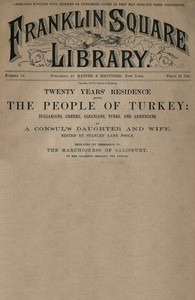
Twenty Years' Residence among the People of Turkey: Bulgarians, Greeks, Albanians, Turks, and Armenians
Written by Fanny Janet Sandison Blunt
Chaptra reads alongside you — AI insights, chapter breakdowns and reader discussions for every book. Join free
About this book
Reading guide
Themes, characters and key ideas in Twenty Years' Residence among the People of Turkey: Bulgarians, Greeks, Albanians, Turks, and Armenians, written by Chaptra AI.
- about 20 hours
- advanced
- informative
- analytical
- historical
Fanny Janet Sandison Blunt's "Twenty Years' Residence among the People of Turkey" is a crucial late 19th-century historical account, edited by Stanley Lane Poole, offering an Englishwoman's detailed observations of various ethnic groups under Ottoman rule. Spanning two decades of direct interaction, the book meticulously examines the social conditions, customs, and nascent national characteristics of Bulgarians, Greeks, Albanians, Turks, and Armenians. Blunt aims to provide a reliable counter-narrative to the often-biased information surrounding the 'Eastern Question,' emphasizing the diverse and complex realities of these communities. The work delves into the historical struggles and developing national identities, particularly highlighting the plight of the Bulgarians under Ottoman oppression while contrasting their experiences with those of other regional groups.
“It is my earnest hope that this work may contribute, however modestly, to a clearer understanding of the complex realities that define the peoples of Turkey, a region so often misunderstood and misrepresented.”
Key themes
- National Identity and Nationalism
- The book extensively explores the nascent and developing national identities of various ethnic groups within the Ottoman Empire, particularly focusing on the Bulgarians. Blunt details how language, religion, customs, and shared historical grievances contribute to a collective sense of self, often in opposition to the ruling Ottoman power. This theme highlights the complex process of national awakening and the aspirations for self-determination that characterized the late 19th century.
- The 'Eastern Question' and Geopolitics
- Blunt frames her entire work as a contribution to understanding the 'Eastern Question' – the diplomatic and political problems posed by the decay of the Ottoman Empire and the scramble for influence among European Great Powers. The book provides crucial ground-level context to this complex geopolitical issue, showing how the lives and aspirations of local populations were intertwined with international power struggles.
- Oppression and Resistance
- A recurring theme is the experience of various non-Muslim and non-Turkish groups living under Ottoman rule, characterized by varying degrees of political, economic, and social oppression. Blunt details the mechanisms of this oppression and, crucially, the myriad forms of resistance—from cultural preservation to nascent political movements—employed by the subjugated populations.
Worth discussing
How does Blunt's 'Western gaze' influence her observations and conclusions about the peoples of Turkey? What are the strengths and limitations of such a perspective?
Chapter-by-chapter breakdowns, character arcs and the full thematic analysis come with a free account.
Discussions
No one has started one yet
Questions this book opens up
No discussions yet
Be the first to start a discussion about this book!
Sign up to start the discussionReviews
No reviews yet
Be the first to review this book!