
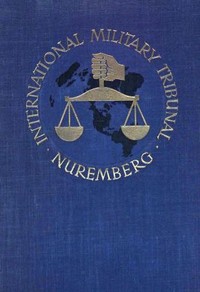
Trial of the Major War Criminals Before the International Military Tribunal, Nuremburg, 14 November 1945-1 October 1946, Volume 01
Written by Various
Chaptra reads alongside you — AI insights, chapter breakdowns and reader discussions for every book. Join free
About this book
Reading guide
Themes, characters and key ideas in Trial of the Major War Criminals Before the International Military Tribunal, Nuremburg, 14 November 1945-1 October 1946, Volume 01, written by Chaptra AI.
- about 30 hours
- advanced
- formal
- somber
- judicial
Volume 01 of "Trial of the Major War Criminals Before the International Military Tribunal" is the foundational official record of the Nuremberg Trials, meticulously documenting the initial proceedings against high-ranking Nazi officials following World War II. Published in the late 1940s, this text outlines the establishment, jurisdiction, and procedural framework of the International Military Tribunal (IMT), which convened in Nuremberg from November 1945 to October 1946. It introduces the key legal documents, the members of the Tribunal, the prosecution teams, and the prominent defendants, such as Hermann Göring and Rudolf Hess. Far more than a mere transcript, this volume serves as a critical historical artifact and a legal precedent, detailing the charges of war crimes, crimes against peace, and crimes against humanity, thereby laying the groundwork for international criminal law and the pursuit of justice for unprecedented atrocities.
“The crimes which we seek to condemn and punish have been so calculated, so malignant, and so devastating, that civilization cannot tolerate their being ignored, because it cannot survive their being repeated.”
Key themes
- Justice and Accountability
- This is the overarching theme. The entire purpose of the IMT and the detailed proceedings documented in Volume 01 is to establish a framework for holding individuals accountable for state-sponsored atrocities, ensuring that crimes of such magnitude do not go unpunished and that a moral reckoning occurs after war.
- The Birth of International Law
- The trials represent a watershed moment in the development of international law, particularly in defining individual criminal responsibility for acts committed during wartime. Volume 01 explicitly details the creation of the legal framework (the Charter) that expanded existing concepts of war crimes to include 'crimes against peace' and 'crimes against humanity,' setting new global legal standards.
- Historical Record and Truth
- Beyond punishment, a primary aim of the trials, as reflected in this volume, was to establish an indisputable historical record of the atrocities committed by the Nazi regime. The meticulous documentation of charges, evidence, and proceedings serves to combat denial and ensure that future generations understand the full scope of the crimes, thereby shaping collective memory.
Worth discussing
To what extent did the Nuremberg Trials establish a lasting precedent for international justice, and how has it influenced subsequent tribunals?
Chapter-by-chapter breakdowns, character arcs and the full thematic analysis come with a free account.
Discussions
No one has started one yet
Questions this book opens up
No discussions yet
Be the first to start a discussion about this book!
Sign up to start the discussionReviews
No reviews yet
Be the first to review this book!