
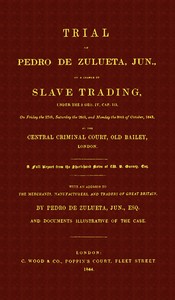
Trial of Pedro de Zulueta, jun., on a Charge of Slave Trading, under 5 Geo. IV, cap. 113, on Friday the 27th, Saturday the 28th, and Monday the 30th of October, 1843, at the Central Criminal Court, Old Bailey, London: A Full Report from the Short-hand Notes of W. B. Gurney, Esq.
Written by William Brodie Gurney,Pedro de Zulueta
Chaptra reads alongside you — AI insights, chapter breakdowns and reader discussions for every book. Join free
About this book
Reading guide
Themes, characters and key ideas in Trial of Pedro de Zulueta, jun., on a Charge of Slave Trading, under 5 Geo. IV, cap. 113, on Friday the 27th, Saturday the 28th, and Monday the 30th of October, 1843, at the Central Criminal Court, Old Bailey, London: A Full Report from the Short-hand Notes of W. B. Gurney, Esq., written by Chaptra AI.
- about 8 hours
- advanced
- Historical
- Legal
- Serious
This book is a verbatim report of the sensational 1843 trial of Pedro de Zulueta, jun., a prominent London merchant, on charges of slave trading under the British Slave Trade Act of 1824 (5 Geo. IV, cap. 113). The trial, held at the Central Criminal Court, Old Bailey, meticulously documents the prosecution's efforts to link Zulueta's legitimate commercial dealings with known slave traders to direct involvement in the illicit trade, and the defense's vigorous counter-arguments. As a full transcript from shorthand notes, it provides an unparalleled primary source into the legal complexities, moral debates, and commercial realities surrounding the suppression of the slave trade in the mid-19th century, ultimately concluding with Zulueta's acquittal.
“"The charge against the defendant is, that he, the said Pedro de Zulueta, junior, did unlawfully, wilfully, and knowingly fit out, man, navigate, equip, despatch, use, and employ a certain vessel, called the Augusta, for the purpose of slave trading."”
Key themes
- Abolition and its Enforcement
- The trial is a direct examination of the practical challenges and limitations of enforcing anti-slavery legislation in the mid-19th century. While Britain had abolished its own slave trade and slavery, prosecuting foreign nationals or those indirectly involved in the international trade proved immensely complex due to issues of jurisdiction, evidence gathering, and the sophisticated networks of slave traders. The trial reveals the gap between legislative intent and effective implementation.
- Justice vs. Law
- This theme explores the tension between the moral imperative to eradicate the slave trade (justice) and the strict legal requirements for proving guilt (law). The prosecution's moral outrage against the slave trade collides with the defense's insistence on precise legal definitions and the burden of proof, highlighting how difficult it was to prosecute individuals whose actions, while facilitating slavery, might technically fall outside the letter of the law.
- Commercial Interests vs. Humanitarianism
- This theme highlights the fundamental conflict between the pursuit of profit and humanitarian concerns. Zulueta's defense argues for the sanctity of legitimate commercial transactions, even when those transactions might inadvertently or indirectly support an abhorrent trade. The trial exposes how economic incentives and established business practices could inadvertently (or knowingly) perpetuate the slave trade, making it difficult to disentangle 'innocent' commerce from complicity.
Worth discussing
To what extent should individuals or companies be held responsible for the illicit actions of their clients or business partners?
Chapter-by-chapter breakdowns, character arcs and the full thematic analysis come with a free account.
Discussions
No one has started one yet
Questions this book opens up
No discussions yet
Be the first to start a discussion about this book!
Sign up to start the discussionReviews
No reviews yet
Be the first to review this book!