
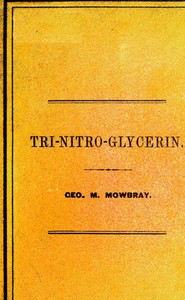
Tri-nitro-glycerine, as Applied in the Hoosac Tunnel, Submarine Blasting, etc., etc., etc.
Written by George M. Mowbray
Chaptra reads alongside you — AI insights, chapter breakdowns and reader discussions for every book. Join free
About this book
Reading guide
Themes, characters and key ideas in Tri-nitro-glycerine, as Applied in the Hoosac Tunnel, Submarine Blasting, etc., etc., etc., written by Chaptra AI.
- about 8 hours
- advanced
- Informative
- Cautionary
- Analytical
George M. Mowbray's "Tri-nitro-glycerine, as Applied in the Hoosac Tunnel, Submarine Blasting, etc." is a pivotal late 19th-century scientific publication detailing the properties, manufacturing, and practical applications of tri-nitro-glycerine. The text thoroughly examines its use in monumental engineering projects like the Hoosac Tunnel and various submarine blasting operations, emphasizing both its immense power and inherent dangers. Mowbray meticulously recounts historical incidents of catastrophic nitro-glycerine explosions, such as those in New York and San Francisco, to underscore the critical need for understanding and rigorous safety protocols. Motivated by the demand for a highly effective blasting agent to advance tunneling, the work synthesizes scientific inquiry with practical engineering reports, advocating for the responsible integration of this potent explosive into industrial progress.
“The destructive power of tri-nitro-glycerine, when uncontrolled, is a testament to its inherent dangers.”
Key themes
- Technological Innovation and Progress
- The book champions the relentless human drive to develop and apply new technologies to overcome natural barriers and advance industrial society. Tri-nitro-glycerine is presented as a revolutionary tool that significantly improved the efficiency and speed of large-scale projects like tunneling and blasting, thereby facilitating infrastructure development and economic growth. Mowbray highlights how scientific discovery directly translates into practical solutions for complex engineering problems.
- Risk, Safety, and Responsibility
- Central to Mowbray's argument is the critical importance of understanding and managing the inherent risks associated with powerful technologies. The book meticulously details past catastrophic accidents involving nitro-glycerine, using these historical lessons to underscore the necessity of stringent safety protocols, proper handling, and informed use. It advocates for a responsible approach to innovation, where scientific knowledge is leveraged not only for application but also for harm prevention.
- Human Ingenuity vs. Destructive Power
- This theme explores the paradox of human innovation—the ability to create tools of immense power that can be harnessed for constructive purposes (tunneling, mining) but also possess inherent destructive capabilities. Mowbray implicitly asks how humanity can control and direct these powerful forces for good, acknowledging the fine line between creation and annihilation. It's a reflection on the dual nature of scientific discovery and the moral responsibility to wield it wisely.
Worth discussing
How does Mowbray balance the promotion of a powerful new technology with the imperative of safety?
Chapter-by-chapter breakdowns, character arcs and the full thematic analysis come with a free account.
Discussions
No one has started one yet
Questions this book opens up
No discussions yet
Be the first to start a discussion about this book!
Sign up to start the discussionReviews
No reviews yet
Be the first to review this book!