
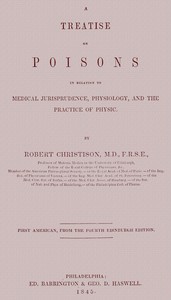
Treatise on Poisons: In relation to medical jurisprudence, physiology, and the practice of physic
Written by Robert Christison
Chaptra reads alongside you — AI insights, chapter breakdowns and reader discussions for every book. Join free
About this book
Reading guide
Themes, characters and key ideas in Treatise on Poisons: In relation to medical jurisprudence, physiology, and the practice of physic, written by Chaptra AI.
- about 30 hours
- advanced
- informative
- analytical
- rigorous
Sir Robert Christison's "Treatise on Poisons" is a seminal 19th-century scientific work that meticulously explores the field of toxicology, particularly its intersections with medical jurisprudence, human physiology, and clinical practice. The treatise comprehensively details the actions of various poisons within the body, differentiating between local and remote effects, and laying a scientific foundation for understanding their mechanisms. Aimed at medical professionals and students, it provides in-depth insights into the physiological impact of toxic substances, their detection, and their relevance in legal contexts. Christison's work stands as a cornerstone in the development of modern toxicology and forensic medicine, emphasizing rigorous observation and scientific methodology.
“Toxicology, at its foundation, is the precise elucidation of how substances, often in minute quantities, perturb the delicate balance of life, and how this knowledge may serve the ends of justice and healing.”
Key themes
- Medical Jurisprudence
- This theme explores the intricate interface between medical science and the legal system, particularly concerning poisoning cases. Christison meticulously details how medical knowledge, diagnostic techniques, and post-mortem examinations are crucial for providing evidence in court, establishing cause of death, and identifying the presence of toxic substances. The book emphasizes the physician's ethical and professional responsibility as an expert witness, ensuring scientific accuracy informs judicial proceedings.
- Physiological Mechanisms of Poisoning
- This theme is central to the treatise, as Christison endeavors to explain *how* poisons exert their effects on the human body. He delves into the specific interactions of various toxic substances with organs, tissues, and bodily systems, distinguishing between localized damage and remote systemic effects. This exploration reflects the evolving understanding of human physiology in the 19th century and forms the scientific bedrock for diagnosis and treatment.
- Scientific Method and Empirical Observation
- Christison's treatise is a testament to the power and necessity of the scientific method in understanding complex phenomena. The book constantly emphasizes rigorous observation, meticulous experimentation (often on animals, which was common practice), and logical deduction as the only reliable means to establish toxicological truths. It champions an evidence-based approach over speculation, reflecting the Enlightenment's influence on scientific inquiry.
Worth discussing
How did 19th-century understanding of human physiology influence toxicological theories, and how has this understanding evolved?
Chapter-by-chapter breakdowns, character arcs and the full thematic analysis come with a free account.
Discussions
No one has started one yet
Questions this book opens up
No discussions yet
Be the first to start a discussion about this book!
Sign up to start the discussionReviews
No reviews yet
Be the first to review this book!