Chaptra

The AI reading companion for people who take books seriously

AI insights, chapter breakdowns, community discussions — all in one place.

Join free
Book0 • 300+ pages • 5+ hours reading time

Travels in the East Indian archipelago

3.7/5
396 readers on Chaptra have this book

About this book

"Travels in the East Indian Archipelago" by Albert S. Bickmore is a detailed travelogue and scientific account written in the late 19th century. The work chronicles Bickmore's journey through the East Indian Archipelago, focusing particularly on the Spice Islands and the collection of natural specimens, notably shells, as well as his observations of local cultures and geography. The narrative combines elements of personal exploration with rich historical context, offering insight into the regions visited. At the start of the travelogue, Bickmore delineates the purpose of his voyage, emphasizing his aim to gather specimens of shells similar to those cataloged by the earlier naturalist Rumphius. As he nears Java, vivid descriptions of the environment, flora, and fauna capture his impressions of the tropical landscape. He recounts his arrival in Batavia, highlighting interactions with the local Malay population and detailing various cultural aspects, including their customs and modes of living. Bickmore's meticulous observations not only serve to document his experiences but also reflect a blend of scientific inquiry and personal narrative.
Language
English
Publisher
Project Gutenberg
Release date
Unknown
Downloads
391

More by Albert S. (Albert Smith) Bickmore

Browse all books by this author

Explore Natural history Books

Discover more Natural history literature
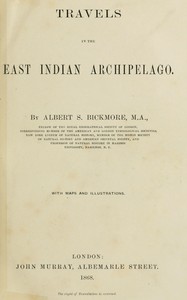
Cover of Travels in the East Indian archipelago

Click "Read now" to open in our Reader with AI features.

Community Discussions

Join the conversation about this book

Discussions

0 discussions

Join

No discussions yet

Be the first to start a discussion about this book!

Sign up to start the discussion

AI-Powered Insights

A clearer way to understand Travels in the East Indian archipelago through themes, characters, and key ideas

This reading guide highlights what stands out in Travels in the East Indian archipelago through 4 core themes, 1 character profile. It is meant to help readers decide whether the book fits their taste and deepen the reading once they begin.

AI Reading GuidePreview

About this book

A quick AI guide to “Travels in the East Indian archipelago

Get the shape of the book before you commit: what it is about, what mood it carries, and what ideas readers tend to stay with afterward.

~12h readadvancedExploratoryInformativeDetailed

What the book is doing

Albert S. Bickmore's "Travels in the East Indian Archipelago" is a late 19th-century travelogue and scientific expedition report, meticulously documenting his journey through the Spice Islands. Driven by the specific aim to collect shell specimens, particularly those cataloged by Rumphius, Bickmore's narrative blends personal exploration with rigorous scientific observation. The work offers vivid descriptions of the tropical landscapes, flora, and fauna of regions like Java, alongside detailed accounts of the local Malay cultures, customs, and daily life encountered in places like Batavia. It stands as a significant historical document, reflecting both the scientific inquiry and the prevailing colonial perspectives of its era.

Key Themes

Exploration and Discovery

This theme is central to the entire narrative, detailing Bickmore's physical journey into uncharted or less-documented territories of the East Indian Archipelago. It encompasses the spirit of adventure, the drive to expand geographical and scientific knowledge, and the personal challenges faced in remote environments. The act of discovery is not just about finding new species but also about encountering different cultures and landscapes.

Natural History and Scientific Inquiry

The book is fundamentally a work of natural history, reflecting the scientific methodologies and interests of the late 19th century. It emphasizes meticulous observation, collection, classification, and documentation of geological features, flora, fauna (especially shells), and environmental conditions. This theme showcases the rigorous process of scientific inquiry during a period of significant advancements in biology and geology.

A line worth noting
My primary object in undertaking this arduous voyage was to gather specimens of those very shells which the illustrious Rumphius had, two centuries before, so admirably cataloged.
A good discussion starter

How does Bickmore's stated scientific purpose influence the narrative and his observations?

Unlock the full reading guide

See chapter-by-chapter takeaways, deeper character arcs, and a fuller literary analysis built around this book.

Unlock full AI analysis for “Travels in the East Indian archipelago

Chapter breakdowns, character deep-dives, and thematic analysis — all in one place.

Reader Reviews

See what others are saying

Reviews

Overall Rating

3.7
400 ratings

Based on community ratings

No reviews yet

Be the first to review this book!

Readers Also Enjoyed

Discover more books similar to Travels in the East Indian archipelago