
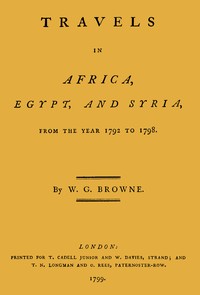
Travels in Africa, Egypt, and Syria, from the year 1792 to 1798
Written by William George Browne
Chaptra reads alongside you — AI insights, chapter breakdowns and reader discussions for every book. Join free
About this book
Reading guide
Themes, characters and key ideas in Travels in Africa, Egypt, and Syria, from the year 1792 to 1798, written by Chaptra AI.
- about 18 hours
- advanced
- Exploratory
- Observational
- Historical
William George Browne's "Travels in Africa, Egypt, and Syria, from the year 1792 to 1798" is a significant late 18th-century historical account documenting his extensive journeys through lesser-known territories. Driven by a desire for authentic discovery, Browne meticulously records the geography, diverse cultures, and local customs he encounters, often contrasting his expectations with the harsh realities of travel. The narrative begins with his reflections on the mixed success of his ambitious undertaking, detailing his initial observations of Alexandria's decline before embarking on a challenging expedition to locate the Temple of Jupiter Ammon in Siwa. Throughout his travels, Browne critiques the inaccuracies of prior accounts, aspiring to provide a more truthful and detailed representation of Northern Africa and the Middle East during a period of considerable geopolitical interest.
“My motivations were a confluence of scholarly curiosity and an insatiable yearning for territories unblemished by copious, yet often inaccurate, report.”
Key themes
- Exploration and Discovery
- The overarching theme of the book, centering on Browne's ambitious and often perilous journey into territories largely unknown to European audiences. It explores the motivations behind such endeavors, the physical and intellectual challenges involved, and the thrill of uncovering new geographical and cultural insights.
- Authenticity vs. Misrepresentation
- A critical theme wherein Browne explicitly challenges the 'sparse and often conflicting accounts' of previous travelers and scholars. He vows to provide an 'authentic representation' based on firsthand experience, highlighting the ethical responsibility of the observer to present truth rather than perpetuate stereotypes or inaccuracies.
- Cultural Encounter and Observation
- This theme explores the interactions between Browne, as a European traveler, and the diverse cultures and peoples he encounters in Africa, Egypt, and Syria. It delves into his observations of their customs, social structures, hospitality, and daily lives, offering a snapshot of intercultural dynamics in the late 18th century.
Worth discussing
How does Browne's stated motivation to provide 'authentic representation' challenge or align with the concept of Orientalism in 18th-century European thought?
Chapter-by-chapter breakdowns, character arcs and the full thematic analysis come with a free account.
Discussions
No one has started one yet
Questions this book opens up
No discussions yet
Be the first to start a discussion about this book!
Sign up to start the discussionReviews
No reviews yet
Be the first to review this book!