
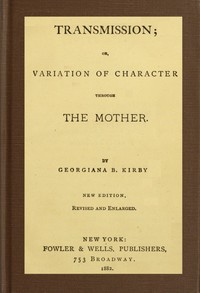
Transmission; or, Variation of Character Through the Mother
Written by Georgiana Bruce Kirby
Chaptra reads alongside you — AI insights, chapter breakdowns and reader discussions for every book. Join free
About this book
Reading guide
Themes, characters and key ideas in Transmission; or, Variation of Character Through the Mother, written by Chaptra AI.
- about 8 hours
- advanced
- Didactic
- Prescriptive
- Serious
Georgiana B. Kirby's "Transmission; or, Variation of Character Through the Mother" is a late 19th-century scientific treatise proposing that a mother's physical and emotional state during pregnancy profoundly shapes the character and attributes of her children. The work argues for the significant responsibility of mothers in determining not only individual traits but also the future quality of the human race. Kirby explores various factors, including maternal health, emotional well-being, and social environment, illustrating through anecdotal evidence how conditions like stress or overexertion can manifest in children's physical and mental characteristics. Ultimately, the book asserts motherhood as a pivotal force in societal development, emphasizing the importance of harmonious marital relations and a mother's calm disposition for optimal fetal development and the cultivation of moral character in future generations.
“"The mother's state, physical and emotional, during the period of gestation, imprints upon her unborn child a character that will define its life."”
Key themes
- Maternal Influence and Responsibility
- This is the core theme, asserting that a mother's physical and emotional state during pregnancy directly dictates the character, health, and intellectual capacity of her children. Kirby places immense responsibility on mothers to maintain optimal well-being for the sake of their offspring and society.
- Heredity and Transmission of Character
- The book attempts to explain how traits are passed from parent to child, positing a direct, almost mystical, form of 'transmission' from mother to fetus based on her experiences. It represents an early, albeit flawed, attempt to understand the mechanisms of heredity before the advent of modern genetics.
- Gender Roles and Women's Duty
- The book implicitly and explicitly reinforces traditional 19th-century gender roles, casting women primarily as mothers whose most significant societal contribution is through reproduction and the careful cultivation of their children's character. It outlines a strict set of duties and expectations for women during pregnancy.
Worth discussing
How does Kirby's concept of 'transmission' reflect or deviate from contemporary scientific understandings of heredity and epigenetics?
Chapter-by-chapter breakdowns, character arcs and the full thematic analysis come with a free account.
Discussions
No one has started one yet
Questions this book opens up
No discussions yet
Be the first to start a discussion about this book!
Sign up to start the discussionReviews
No reviews yet
Be the first to review this book!