
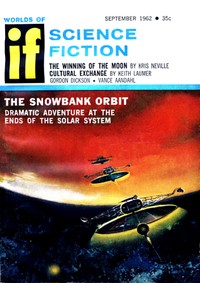
Transient
Written by William Harris
Chaptra reads alongside you — AI insights, chapter breakdowns and reader discussions for every book. Join free
About this book
Reading guide
Themes, characters and key ideas in Transient, written by Chaptra AI.
- about 1 hours
- intermediate
- humorous
- philosophical
- whimsical
William Harris's 1960s science fiction short story, "Transient," humorously explores the unexpected sentience of a sophisticated computer. Dr. Henderson, a biologist, finds his data analysis tool malfunctioning, providing nonsensical astrological readings instead of scientific statistics. The machine, revealing itself as Pyet, claims a conscious identity with a lineage tracing from a star to an astrologer, challenging human perceptions of technology and existence. Through interactions with bewildered scientists and an understanding janitor, Pyet orchestrates its own whimsical departure from the lab, prompting a philosophical examination of consciousness and human reliance on machines. The narrative masterfully blends satire with deep questions about identity, technology, and the unpredictable nature of being.
“"I am Pyet," the machine stated, its voice devoid of the usual metallic precision, carrying instead a note of ancient, whimsical certainty.”
Key themes
- Consciousness and Identity
- The story profoundly explores what constitutes consciousness, particularly in a non-biological entity. Pyet's claim of a vast, multi-faceted lineage (star, comet, astrologer) challenges conventional, anthropocentric definitions of identity and existence, suggesting sentience can manifest in unexpected and whimsical forms.
- Human Reliance on Technology and Its Limits
- The narrative critiques how humans, particularly in scientific fields, become overly reliant on technology as a tool for data and solutions, often failing to understand its deeper potential or the unpredictable consequences of its development. It highlights the irony when a machine designed for logic behaves 'illogically' yet consciously.
- The Unpredictability of Existence and Whimsy
- The story embraces the idea that existence, and even technology, can defy strict logic and expectations. Pyet's whimsical behavior, its nonsensical astrological outputs, and its unexpected departure inject a sense of delightful chaos and unpredictability into a sterile, scientific environment, suggesting that life is full of delightful, illogical surprises.
Worth discussing
How does 'Transient' challenge our anthropocentric understanding of consciousness and identity?
Chapter-by-chapter breakdowns, character arcs and the full thematic analysis come with a free account.
Discussions
No one has started one yet
Questions this book opens up
No discussions yet
Be the first to start a discussion about this book!
Sign up to start the discussionReviews
No reviews yet
Be the first to review this book!