
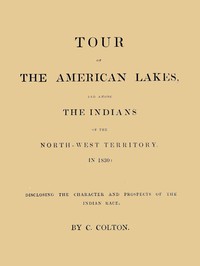
Tour of the American Lakes, and Among the Indians of the North-West Territory, in 1830, Volume 1 (of 2): Disclosing the Character and Prospects of the Indian Race
Written by Calvin Colton
Chaptra reads alongside you — AI insights, chapter breakdowns and reader discussions for every book. Join free
About this book
Reading guide
Themes, characters and key ideas in Tour of the American Lakes, and Among the Indians of the North-West Territory, in 1830, Volume 1 (of 2): Disclosing the Character and Prospects of the Indian Race, written by Chaptra AI.
- about 12 hours
- advanced
- reflective
- historical
- exploratory
Calvin Colton's "Tour of the American Lakes, and Among the Indians of the North-West Territory, in 1830, Volume 1" is a historical travelogue documenting the author's journey through the Great Lakes region and his observations of Native American tribes. Written in the early 19th century, the book aims to shed light on the character and future prospects of Indigenous peoples during a period of significant cultural transition and conflict with encroaching European influences. Colton's narrative begins with a romanticized fascination for the American wilderness and a desire to understand the 'wild Indians' in their unadulterated state, contrasting them with those already impacted by 'civilization.' Ultimately, it offers a sympathetic yet inherently paternalistic perspective on the challenges faced by Native Americans amidst governmental pressures and societal change.
“Illustrative quote reflecting the author's motivation: 'It was with a yearning for the profound, untamed spirit of this continent that I set forth, drawn by the whispers of the wilderness and the enigma of its first inhabitants.'”
Key themes
- Clash of Cultures and Cultural Transition
- This is the central theme, as Colton explicitly aims to disclose the 'character and prospects of the Indian race' during a time of 'transition and conflict.' The book explores the dramatic impact of European expansion and 'civilizing' influences on Native American societies, detailing how traditional ways of life, social structures, and spiritual beliefs are challenged by new settlers, technologies, and governmental pressures. It highlights the tension between two fundamentally different worldviews.
- Romanticism of the Wilderness and the 'Noble Savage'
- Colton's narrative is imbued with a romantic fascination for the 'natural beauty and cultural richness of the American wilderness' and a longing to understand the 'wild Indians in their undiluted form.' This reflects the 19th-century idealization of nature and the 'noble savage' trope, where Indigenous peoples are seen as pure, uncorrupted embodiments of nature, often contrasted with the perceived artificiality of 'civilized' society. This perspective, while seemingly sympathetic, can also be dehumanizing by stripping individuals of their complex realities.
- Colonialism and Manifest Destiny (Implicit)
- While not explicitly named by Colton, the underlying forces of colonialism and the nascent ideology of Manifest Destiny are pervasive. The 'encroaching European influences' and 'governmental pressures' mentioned in the summary are direct manifestations of a nation expanding its territory and imposing its worldview. Colton's reflections on the 'prospects' of Indigenous peoples implicitly engage with the idea of their eventual assimilation or displacement, a core tenet of colonial expansion.
Worth discussing
How does Colton's 'sympathy' for Indigenous peoples compare with modern understandings of cultural respect and sovereignty?
Chapter-by-chapter breakdowns, character arcs and the full thematic analysis come with a free account.
Discussions
No one has started one yet
Questions this book opens up
No discussions yet
Be the first to start a discussion about this book!
Sign up to start the discussionReviews
No reviews yet
Be the first to review this book!