
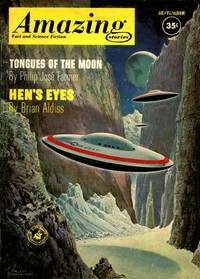
Tongues of the Moon
Written by Philip José Farmer
Chaptra reads alongside you — AI insights, chapter breakdowns and reader discussions for every book. Join free
About this book
Reading guide
Themes, characters and key ideas in Tongues of the Moon, written by Chaptra AI.
- about 8 hours
- intermediate
- post-apocalyptic
- dystopian
- philosophical
Philip José Farmer's "Tongues of the Moon" plunges readers into a post-apocalyptic future where humanity has retreated to a sterile, technologically advanced Moon colony, while Earth lies devastated by a biological weapon known as the Death-Dust. The narrative follows Captain John Carmody, a disillusioned but capable agent, who is tasked with a perilous mission: to return to the toxic, mutated Earth to retrieve a vital "seed" that holds the key to the Moon's dwindling future. As Carmody navigates the ravaged planet, he confronts not only the monstrous remnants of life but also the profound moral and existential questions surrounding humanity's past mistakes and its capacity for rebirth, ultimately challenging the rigid ideologies of the Lunar society.
“"The Moon was sterile, a perfect machine of logic, but Earth… Earth was the beating heart, however corrupted."”
Key themes
- Nature vs. Technology
- The central conflict of the novel is embodied by the sterile, technologically advanced Moon colony and the wild, biologically diverse, mutated Earth. Farmer explores the dangers of relying solely on technology to solve human problems, showing how the Lunies' pursuit of artificial perfection has led to emotional and genetic stagnation. Conversely, Earth, despite its horrors, represents raw, untamed life and the power of natural selection and adaptation.
- Consequences of Scientific Hubris
- The Death-Dust, a biological weapon that transformed Earth, is a direct result of humanity's unchecked scientific ambition. Farmer critiques the idea that science without ethical foresight can lead to disaster, not just in terms of destruction, but also in creating unforeseen, monstrous new forms of life. The Lunies themselves, products of a highly controlled scientific society, are also suffering the long-term consequences of their ancestors' choices.
- Rebirth and Adaptation
- Despite the apocalyptic setting, a powerful theme of the novel is the capacity for life to adapt and be reborn even from utter devastation. Earth, far from being truly dead, is teeming with new, vibrant, and often terrifying life forms, including new types of humans. This theme challenges the notion of a single, 'correct' form of humanity or civilization, suggesting that life's true strength lies in its ability to change and find new ways to exist.
Worth discussing
How does Farmer portray the Moon colony as a 'dystopian utopia'? What are the inherent flaws in their society?
Chapter-by-chapter breakdowns, character arcs and the full thematic analysis come with a free account.
Discussions
No one has started one yet
Questions this book opens up
No discussions yet
Be the first to start a discussion about this book!
Sign up to start the discussionReviews
No reviews yet
Be the first to review this book!