
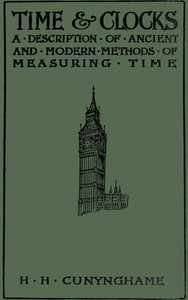
Time and Clocks: A Description of Ancient and Modern Methods of Measuring Time
Written by Henry H. (Henry Hardinge) Cunynghame
Chaptra reads alongside you — AI insights, chapter breakdowns and reader discussions for every book. Join free
About this book
Reading guide
Themes, characters and key ideas in Time and Clocks: A Description of Ancient and Modern Methods of Measuring Time, written by Chaptra AI.
- about 12 hours
- advanced
- informative
- analytical
- scholarly
Sir Henry H. Cunynghame's 'Time and Clocks' is an early 20th-century scientific treatise that meticulously traces the evolution of time measurement from ancient civilizations to contemporary advancements. The book not only details the technical development of clocks and timekeeping methods but also delves into the profound philosophical implications of time as a fundamental concept. Cunynghame posits the superiority of modern scientific progress, particularly in physical sciences and time measurement, over past artistic and philosophical endeavors. It serves as both a historical survey of chronometry and a reflective essay on humanity's evolving understanding of time's significance in the natural world and human history.
“Time, the most fundamental yet elusive of all concepts, underpins our understanding of both the cosmos and human endeavor.”
Key themes
- The Evolution of Scientific Understanding and Technology
- This is a central theme, tracing humanity's journey from rudimentary observations of natural cycles to highly precise mechanical and scientific methods of time measurement. Cunynghame uses this evolution to underscore the progress of human intellect and the power of scientific inquiry.
- The Philosophical Nature of Time
- Beyond the mechanics, the book deeply explores time as an abstract concept. It delves into how different cultures and eras have perceived time (linear vs. cyclical, subjective vs. objective) and how these perceptions have influenced human thought, religion, and societal structures. Cunynghame sets the stage for technical discussions by first establishing the profound 'why' behind humanity's obsession with time.
- Progress and Superiority of Modern Science
- A prominent underlying argument in the book is Cunynghame's belief in the definitive progress achieved by modern scientific advancements, particularly in physical sciences and time measurement. He explicitly argues for their superiority over past artistic and purely philosophical achievements, viewing scientific mastery as the pinnacle of human intellectual development.
Worth discussing
Cunynghame argues for the superiority of modern scientific advancements over past artistic and philosophical achievements. Do you agree with this perspective, and how has this view evolved since the early 20th century?
Chapter-by-chapter breakdowns, character arcs and the full thematic analysis come with a free account.
Discussions
No one has started one yet
Questions this book opens up
No discussions yet
Be the first to start a discussion about this book!
Sign up to start the discussionReviews
No reviews yet
Be the first to review this book!