
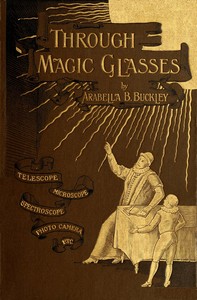
Through Magic Glasses and Other Lectures: A Sequel to The Fairyland of Science
Written by Arabella B. (Arabella Burton) Buckley
Chaptra reads alongside you — AI insights, chapter breakdowns and reader discussions for every book. Join free
About this book
Reading guide
Themes, characters and key ideas in Through Magic Glasses and Other Lectures: A Sequel to The Fairyland of Science, written by Chaptra AI.
- about 8 hours
- intermediate
- Educational
- Wondrous
- Inspiring
Arabella B. Buckley's "Through Magic Glasses and Other Lectures" serves as a captivating sequel to "The Fairyland of Science," offering young readers a journey into the wonders of the natural world as revealed by scientific instruments. Set against the evocative backdrop of a 'magician' observing a lunar eclipse from his turret chamber, the book uses this framing device to introduce a series of lectures on various scientific concepts. Buckley masterfully employs optical tools like telescopes and microscopes as 'magic glasses' to unveil the unseen complexities of the universe, from celestial bodies to microscopic life. The work consistently champions curiosity and observation, inspiring its audience to explore science as a path to understanding the intricate beauty surrounding them. It stands as a testament to late 19th-century efforts to popularize science and foster a lifelong appreciation for discovery among the youth.
“"For what is science, if not the truest magic, revealing wonders beyond the wildest dreams of ancient sorcerers?"”
Key themes
- The Wonder of Scientific Discovery
- This is the overarching theme, equating scientific understanding with a profound sense of awe and 'magic.' Buckley consistently highlights how scientific tools and methods unveil breathtaking complexities and beauties in the universe, transforming the mundane into the miraculous. The book aims to instill a sense of wonder that fuels further exploration.
- The Power of Observation and Instruments
- The book explicitly demonstrates how human perception is limited and how scientific instruments extend our senses, allowing us to perceive phenomena that would otherwise remain hidden. It champions the empirical method, emphasizing that careful observation, aided by technology, is the foundation of scientific knowledge.
- Education and the Cultivation of Curiosity
- At its core, the book is an educational endeavor, aiming to inspire young readers, particularly 'working lads,' to engage with science. It promotes the idea that knowledge is accessible and that curiosity is a valuable trait to be nurtured. The Magician acts as a model educator, passionate about sharing knowledge and fostering intellectual growth.
Worth discussing
How does Buckley use the concept of 'magic' to make science more appealing to young readers? Is this approach still effective today?
Chapter-by-chapter breakdowns, character arcs and the full thematic analysis come with a free account.
Discussions
No one has started one yet
Questions this book opens up
No discussions yet
Be the first to start a discussion about this book!
Sign up to start the discussionReviews
No reviews yet
Be the first to review this book!