
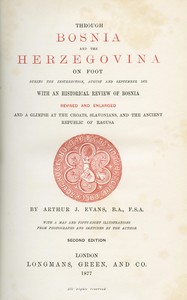
Through Bosnia and the Herzegóvina on foot during the insurrection, August and September 1875
Written by Arthur Evans
Chaptra reads alongside you — AI insights, chapter breakdowns and reader discussions for every book. Join free
About this book
Reading guide
Themes, characters and key ideas in Through Bosnia and the Herzegóvina on foot during the insurrection, August and September 1875, written by Chaptra AI.
- about 8 hours
- advanced
- historical
- observant
- adventurous
Arthur J. Evans's "Through Bosnia and the Herzegóvina on foot during the insurrection, August and September 1875" is a seminal historical travel account documenting his journey through the volatile Balkan region amidst an active insurrection against Ottoman rule. Accompanied by his brother, Evans embarked on this perilous expedition with the explicit goal of understanding the South-Slavonic people, particularly the Sclavonic Muslims, and their historical struggles. Despite carrying a letter of safe passage, the narrative details the significant risks encountered while offering a meticulous examination of the region's history, culture, and the socio-political dynamics fueling the conflict. The book serves as a crucial contemporary record, shedding light on the local population's plight and the implications of the ongoing political strife for the future of the Balkans.
“The air of Bosnia, even in its most verdant valleys, was thick with the dust of history, and the scent of revolution hung heavy upon the mountain passes.”
Key themes
- The Decline of the Ottoman Empire and Rise of Nationalism
- This theme is central to the book, as Evans documents a region embroiled in an insurrection against its imperial ruler. It illustrates the weakening grip of the Ottoman Empire over its European provinces and the burgeoning nationalist sentiments among the South Slavs. The narrative explores the desire for self-determination that fueled the uprising, providing a crucial snapshot of the forces that would eventually redraw the political map of the Balkans.
- Cultural and Ethnic Identity in the Balkans
- Evans's journey is explicitly motivated by a desire to understand the "South-Slavonic people," with a particular focus on the "Sclavonic Muslims." The book delves into the complex and often fluid tapestry of identities in the region, examining how religion (Orthodox, Catholic, Muslim) and ethnicity intersect and sometimes clash. It highlights the often contested nature of identity in a multi-ethnic, multi-religious, and historically conflict-ridden area.
- The Role of the Foreign Observer/Traveler
- The narrative implicitly explores the position of an educated European traveler observing a region in crisis. Evans acts as both an adventurer and an academic, attempting to provide an objective account while inevitably filtering events through his own cultural and historical lens. This theme prompts reflection on the possibility of true objectivity, the responsibility of documentation, and the inherent biases in historical accounts from external perspectives.
Worth discussing
How does Evans's perspective as a foreign observer shape his understanding and portrayal of the Bosnian insurrection?
Chapter-by-chapter breakdowns, character arcs and the full thematic analysis come with a free account.
Discussions
No one has started one yet
Questions this book opens up
No discussions yet
Be the first to start a discussion about this book!
Sign up to start the discussionReviews
No reviews yet
Be the first to review this book!