
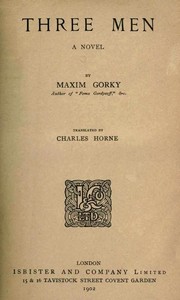
Three Men: A Novel
Written by Maksim Gorky
Chaptra reads alongside you — AI insights, chapter breakdowns and reader discussions for every book. Join free
About this book
Reading guide
Themes, characters and key ideas in Three Men: A Novel, written by Chaptra AI.
- about 9 hours
- intermediate
- somber
- introspective
- bleak
Maksim Gorky's "Three Men: A Novel" delves into the lives of Antipa Lunev, his son Jakov, and his brother Terenti, set against the stark backdrop of late 19th-century rural Russia. The narrative begins with Antipa, a pious hermit burdened by a mysterious past, whose life of isolation and prayer casts a long shadow over his family. Following his death, the story pivots to his two sons, exploring their divergent paths: Jakov, rebellious and confrontational, and the timid, hunchbacked Terenti. The novel profoundly examines themes of solitude, existential struggle, family legacy, and the harsh realities of life, underscored by Gorky's poignant observations on faith, morality, and human resilience.
“The world is a harsh teacher, and its lessons are often carved in the soul.”
Key themes
- Existential Struggle and the Search for Meaning
- The novel deeply explores the characters' struggle to find purpose and meaning in a seemingly indifferent world. Each man grapples with fundamental questions about life, death, faith, and the value of their existence, particularly in the face of suffering and limited opportunities.
- Solitude and Isolation
- The theme of solitude is central, explored through Antipa's hermitage and the internal isolation felt by his sons. It examines whether solitude is a chosen path for spiritual growth, a consequence of societal alienation, or an inherent aspect of the human condition in a harsh world.
- Family Dynamics and Legacy
- The relationship between Antipa and his sons, and between the brothers themselves, forms the core of the narrative. It explores how parental choices, unresolved conflicts, and inherited traits shape the destinies of future generations, highlighting the burden and influence of family history.
Worth discussing
How does Antipa's decision to become a hermit impact the lives of his sons, Jakov and Terenti, both directly and indirectly?
Chapter-by-chapter breakdowns, character arcs and the full thematic analysis come with a free account.
Discussions
No one has started one yet
Questions this book opens up
No discussions yet
Be the first to start a discussion about this book!
Sign up to start the discussionReviews
No reviews yet
Be the first to review this book!