
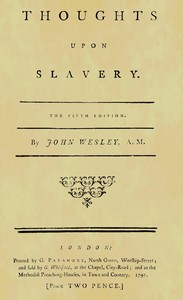
Thoughts upon slavery
Written by John Wesley
Chaptra reads alongside you — AI insights, chapter breakdowns and reader discussions for every book. Join free
About this book
Reading guide
Themes, characters and key ideas in Thoughts upon slavery, written by Chaptra AI.
- about 8 hours
- intermediate
- serious
- indignant
- moral
John Wesley's "Thoughts upon Slavery" is a powerful late 18th-century polemic that vehemently condemns the institution of slavery, particularly the African slave trade. As a foundational figure of Methodism, Wesley leverages his theological platform to argue that slavery is a grave violation of natural justice, human dignity, and Christian principles. The essay systematically critiques the brutal procurement methods, the inhumane conditions of transportation, and the dehumanizing treatment of enslaved individuals in the Americas. Wesley's impassioned plea serves as a call to conscience, urging his contemporaries to recognize the inherent rights of all people and to act with compassion and justice against oppression, advocating for immediate abolition.
“Slavery is an open violation of all divine and human laws.”
Key themes
- Moral Injustice of Slavery
- This is the central theme, arguing that slavery is an inherent evil, fundamentally incompatible with divine and human laws. Wesley details how it violates every principle of fairness, compassion, and justice.
- Natural Rights and Human Dignity
- Wesley argues that all human beings, regardless of race or origin, are born with inherent rights, most notably the right to liberty. He posits that these rights are divinely ordained and cannot be legitimately revoked or denied by any human institution.
- Religious/Christian Duty to Oppose Injustice
- A core aspect of Wesley's argument is that Christians have a moral and spiritual imperative to actively oppose slavery. He frames the fight against slavery not just as a social reform but as a direct command from God, linking it to the principles of love, charity, and justice central to Christian faith.
Worth discussing
How does Wesley use his theological background to strengthen his arguments against slavery, and how effective is this approach for a diverse audience?
Chapter-by-chapter breakdowns, character arcs and the full thematic analysis come with a free account.
Discussions
No one has started one yet
Questions this book opens up
No discussions yet
Be the first to start a discussion about this book!
Sign up to start the discussionReviews
No reviews yet
Be the first to review this book!