
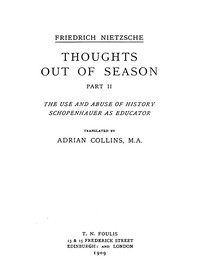
Thoughts Out of Season, Part II
Written by Friedrich Wilhelm Nietzsche
Chaptra reads alongside you — AI insights, chapter breakdowns and reader discussions for every book. Join free
About this book
Reading guide
Themes, characters and key ideas in Thoughts Out of Season, Part II, written by Chaptra AI.
- about 8 hours
- advanced
- philosophical
- critical
- provocative
Thoughts Out of Season, Part II compiles two crucial essays by Nietzsche: "On the Advantage and Disadvantage of History for Life" and "Schopenhauer as Educator." In the first, Nietzsche critiques an excessive, paralyzing historical sense prevalent in his time, arguing that an overabundance of historical knowledge can stifle action, creativity, and genuine life. He advocates for a selective, life-serving approach to history, balanced with the vital capacity for forgetfulness, leading to 'unhistorical' and 'supra-historical' living. The second essay champions the role of the true educator, exemplified by Schopenhauer, who inspires individuals to achieve their authentic selves and overcome the mediocrity of their age. Together, these essays lay foundational stones for Nietzsche's later philosophy, emphasizing vitality, self-mastery, and a radical re-evaluation of cultural values.
“Forgetting is not merely a vis inertiae, as the superficial imagine; it is rather an active and in the strictest sense positive faculty of repression.”
Key themes
- The Use and Abuse of History
- This is the central theme of the first essay, exploring how historical knowledge can either serve life by inspiring action and identity, or hinder it by paralyzing the will, fostering cynicism, and promoting mere imitation. Nietzsche dissects the 'historical malady' and advocates for a balanced, life-affirming approach to the past.
- Authenticity and Self-Overcoming
- Prominent in 'Schopenhauer as Educator,' this theme stresses the imperative for individuals to discover and actualize their unique potential ('become what you are'). It’s a call to move beyond conformity and societal expectations to cultivate an authentic self, often through a process of struggle and transformation.
- The Role of the Educator/Genius
- This theme explores the critical function of inspiring figures—'educators' or 'geniuses'—who do not merely transmit information but awaken potential and guide individuals towards their authentic selves. Nietzsche contrasts this with the superficiality of contemporary academic and cultural institutions.
Worth discussing
Nietzsche argues that an excess of history can paralyze action. Do you agree, and how might this manifest in contemporary society?
Chapter-by-chapter breakdowns, character arcs and the full thematic analysis come with a free account.
Discussions
No one has started one yet
Questions this book opens up
No discussions yet
Be the first to start a discussion about this book!
Sign up to start the discussionReviews
No reviews yet
Be the first to review this book!