
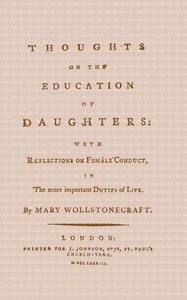
Thoughts on the Education of Daughters: With Reflections on Female Conduct, in the More Important Duties of Life
Written by Mary Wollstonecraft
Chaptra reads alongside you — AI insights, chapter breakdowns and reader discussions for every book. Join free
About this book
Reading guide
Themes, characters and key ideas in Thoughts on the Education of Daughters: With Reflections on Female Conduct, in the More Important Duties of Life, written by Chaptra AI.
- about 5 hours
- intermediate
- instructive
- earnest
- critical
Mary Wollstonecraft's "Thoughts on the Education of Daughters" is a foundational 18th-century treatise advocating for a rational and virtuous education for girls, departing from the prevailing emphasis on superficial accomplishments. Wollstonecraft argues that education should cultivate reason, moral character, and self-discipline to prepare women for their essential duties in life, particularly as mothers and managers of the household. She critiques societal norms that limit women's intellectual development and leave them vulnerable, proposing instead an upbringing focused on truth, benevolence, and practical skills. The work serves as an early articulation of her feminist ideals, laying groundwork for her later, more radical arguments for women's rights to education and independence, emphasizing that a well-educated woman benefits both herself and society.
“"The mind, by being too much employed on external objects, loses its power of reflecting, and by being kept from a free exertion, becomes enervated."”
Key themes
- The Importance of Rational Education for Women
- Wollstonecraft argues vehemently that women, like men, possess reason and that its cultivation through education is paramount. She critiques systems that deny women intellectual development, asserting that a rational education is essential not only for personal fulfillment but also for fulfilling their domestic and societal duties effectively.
- Cultivation of Virtue and Moral Character
- Central to Wollstonecraft's argument is that education should primarily focus on instilling virtue, benevolence, and self-discipline. She believes that true happiness and a meaningful life stem from a strong moral foundation, which is developed through deliberate moral training from infancy. This virtue is not passive but an active, reasoned choice.
- Critique of Superficial Accomplishments and Societal Expectations
- Wollstonecraft sharply criticizes the prevailing educational practices that prioritize surface-level accomplishments (like singing, dancing, or drawing) and an overemphasis on physical beauty and fashion. She argues these pursuits make women vain, idle, and dependent, leaving them ill-prepared for the realities of life or for cultivating genuine relationships.
Worth discussing
How does Wollstonecraft's vision of female education differ from the prevailing norms of her time? What specific practices does she critique?
Chapter-by-chapter breakdowns, character arcs and the full thematic analysis come with a free account.
Discussions
No one has started one yet
Questions this book opens up
No discussions yet
Be the first to start a discussion about this book!
Sign up to start the discussionReviews
No reviews yet
Be the first to review this book!