
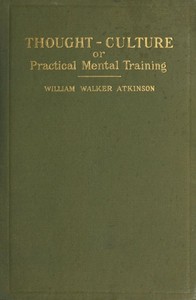
Thought-Culture; Or, Practical Mental Training
Written by William Walker Atkinson
Chaptra reads alongside you — AI insights, chapter breakdowns and reader discussions for every book. Join free
About this book
Reading guide
Themes, characters and key ideas in Thought-Culture; Or, Practical Mental Training, written by Chaptra AI.
- about 8 hours
- intermediate
- uplifting
- instructive
- philosophical
William Walker Atkinson's "Thought-Culture; Or, Practical Mental Training" is an early 20th-century self-help guide advocating for the systematic development of one's mental faculties. Grounded in the burgeoning "New Psychology Movement," the book posits that thought is humanity's most potent tool for overcoming limitations and achieving progress. Atkinson outlines principles and practical exercises designed to train the intellect, emphasizing cultivation of concentration, attention, and reasoning. The ultimate goal is personal mastery and societal betterment through a disciplined and powerful mind. It serves as a foundational text for understanding the early New Thought movement's approach to mental self-improvement and its enduring influence on personal development literature.
“Thought is the vital operation of the intellect, the means whereby humanity has risen above the brute.”
Key themes
- Mental Discipline and Self-Mastery
- This is the core theme of the book, emphasizing that the human mind is not merely a given but a faculty to be rigorously trained and controlled. Atkinson argues that just as one trains a physical body, the intellect must be subjected to systematic discipline to achieve its full potential. This involves cultivating focus, attention, and conscious direction of thought, leading to greater self-control and effectiveness in all aspects of life.
- The Power of Thought and Creation
- Atkinson posits that thought is not just an internal process but a creative force with tangible effects on one's reality and the world. This theme explores the idea that by consciously directing one's thoughts, individuals can shape their experiences, achieve goals, and influence outcomes. It aligns with the New Thought concept of 'mind over matter' and the law of attraction, suggesting an intrinsic connection between mental states and external manifestations.
- Personal and Societal Progress
- The book frames individual mental training not just as a personal endeavor but as a contribution to collective human advancement. Atkinson suggests that by cultivating their intellectual powers, individuals not only enhance their own lives but also contribute to the overall progress and betterment of society. This theme links personal development to a broader humanitarian vision, implying a ripple effect where improved individual minds lead to a more enlightened and capable populace.
Worth discussing
How does Atkinson's 'New Psychology Movement' compare to modern understandings of psychology and neuroscience?
Chapter-by-chapter breakdowns, character arcs and the full thematic analysis come with a free account.
Discussions
No one has started one yet
Questions this book opens up
No discussions yet
Be the first to start a discussion about this book!
Sign up to start the discussionReviews
No reviews yet
Be the first to review this book!