
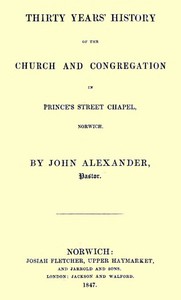
Thirty years' history of the church and congregation in Prince's Street Chapel, Norwich
Written by John Alexander
Chaptra reads alongside you — AI insights, chapter breakdowns and reader discussions for every book. Join free
About this book
Reading guide
Themes, characters and key ideas in Thirty years' history of the church and congregation in Prince's Street Chapel, Norwich, written by Chaptra AI.
- about 8 hours
- intermediate
- historical
- earnest
- communal
John Alexander's "Thirty Years' History of the Church and Congregation in Prince's Street Chapel, Norwich" is a detailed 1847 memoir chronicling the establishment and growth of a Nonconformist church from 1817 to 1847. The account, authored by the minister himself, traces the journey from his arrival in Norwich, through the foundation of the church and the construction of Prince’s Street Chapel, to the development of various spiritual and educational initiatives. It highlights the congregation's collective efforts, resilience in overcoming financial challenges, and the unifying power of shared faith. The book offers a valuable primary source for understanding 19th-century Nonconformist Christianity, community building, and religious life in provincial England.
“"From humble beginnings, fostered by divine grace and congregational zeal, did Prince's Street Chapel rise, a testament to faith's enduring power."”
Key themes
- Faith and Piety
- This is the foundational theme, exploring the profound role of religious belief in the lives of the congregants and in the establishment and endurance of the chapel. Alexander emphasizes how faith provides guidance, strength, and purpose, driving both individual devotion and collective action.
- Community Building and Unity
- The book meticulously details how a disparate group of individuals coalesces into a cohesive and supportive community. This theme explores the mechanisms of unity, mutual support, and shared purpose that bind the congregation together, enabling them to achieve common goals.
- Nonconformist Identity and Practice
- The book provides a direct insight into the specific tenets and practices of Nonconformist Christianity in 19th-century England. It implicitly showcases the distinctiveness of Congregationalism, its emphasis on congregational autonomy, voluntary association, and a commitment to evangelical principles, contrasting with the established Church of England.
Worth discussing
How does Alexander's account illuminate the challenges and rewards of establishing a new religious community in 19th-century England?
Chapter-by-chapter breakdowns, character arcs and the full thematic analysis come with a free account.
Discussions
No one has started one yet
Questions this book opens up
No discussions yet
Be the first to start a discussion about this book!
Sign up to start the discussionReviews
No reviews yet
Be the first to review this book!