
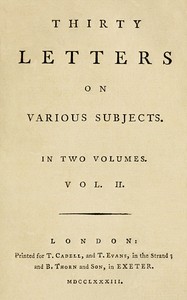
Thirty Letters on Various Subjects, Vol. 2 (of 2)
Written by William Jackson
Chaptra reads alongside you — AI insights, chapter breakdowns and reader discussions for every book. Join free
About this book
Reading guide
Themes, characters and key ideas in Thirty Letters on Various Subjects, Vol. 2 (of 2), written by Chaptra AI.
- about 15 hours
- advanced
- Reflective
- Critical
- Philosophical
William Jackson's "Thirty Letters on Various Subjects, Vol. 2 (of 2)" is a late 18th-century collection offering deep intellectual engagement with the cultural and artistic currents of its time. Through an epistolary format, Jackson navigates diverse subjects including literature, art, and philosophy, reflecting the critical spirit of the Enlightenment era. This volume specifically delves into detailed critiques of literary figures like Shakespeare and Quarles, alongside discussions on artistic principles such as coloring and perspective in painting. It serves as a rich repository of personal reflections and scholarly analysis, showcasing Jackson's role as a discerning critic and a thoughtful philosopher grappling with the evolution of human expression and societal thought.
“One finds in Shakespeare a genius unparalleled in its grasp of human nature, though not without those occasional lapses in taste common to the age; while Quarles, for all his devout sentiment, often strains the bounds of poetic grace.”
Key themes
- Literary Criticism and Interpretation
- This theme explores Jackson's rigorous analysis of literary works, particularly those of poets like Shakespeare and Quarles. He delves into their merits and shortcomings, discussing poetic technique, thematic depth, and the impact of their writing on the reader. This theme highlights the developing discipline of literary criticism in the 18th century, moving towards systematic evaluation.
- Artistic Expression and Aesthetics
- Jackson examines the principles underlying visual art, discussing elements such as color theory (warm vs. cold coloring) and the rules of perspective. This theme delves into the philosophical underpinnings of beauty, artistic technique, and the viewer's experience, reflecting 18th-century aesthetic theories and the distinction between technical mastery and emotional impact.
- The Nature of Genius and Inspiration
- This theme explores Jackson's reflections on what constitutes 'genius'—its origins, manifestations, and its relationship to societal norms and expectations. He considers whether genius is innate or cultivated, and how it expresses itself through various artistic and intellectual endeavors, often defying conventional rules and perceptions.
Worth discussing
How does Jackson's approach to literary criticism compare with modern critical theories?
Chapter-by-chapter breakdowns, character arcs and the full thematic analysis come with a free account.
Discussions
No one has started one yet
Questions this book opens up
No discussions yet
Be the first to start a discussion about this book!
Sign up to start the discussionReviews
No reviews yet
Be the first to review this book!