
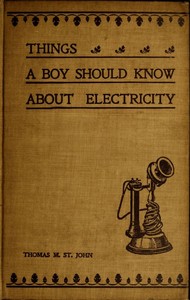
Things a Boy Should Know About Electricity: Second Edition
Written by Thomas M. (Thomas Matthew) St. John
Chaptra reads alongside you — AI insights, chapter breakdowns and reader discussions for every book. Join free
About this book
Reading guide
Themes, characters and key ideas in Things a Boy Should Know About Electricity: Second Edition, written by Chaptra AI.
- about 12 hours
- beginner
- instructive
- curious
- practical
Thomas M. St. John's "Things a Boy Should Know About Electricity: Second Edition" is an early 20th-century instructional manual designed to introduce young readers, specifically boys, to the fundamental principles of electricity. Through clear language and practical, hands-on experiments, the book demystifies concepts like static electricity, magnetism, and basic electrical phenomena. It aims to cultivate scientific curiosity and a foundational understanding of electrical science, emphasizing historical context and encouraging self-discovery. This guide serves as a pedagogical tool, making complex scientific ideas accessible and engaging for novices in an era when formal science education was less widespread.
“"The world of electricity is a fascinating one, ready to reveal its secrets to the curious mind."”
Key themes
- Scientific Inquiry and Experimentation
- This is the central theme, emphasizing that true understanding of science comes not just from reading, but from active observation, questioning, and hands-on experimentation. The book is structured around practical activities that allow the reader to directly interact with electrical phenomena.
- Accessibility of Science
- The book aims to make the complex world of electricity comprehensible and approachable for young novices. It uses simple language, relatable examples, and a step-by-step approach to break down intimidating scientific concepts into digestible parts, demonstrating that science is not just for experts.
- Self-Education and Practical Learning
- St. John's manual encourages independent learning and the development of practical skills. It empowers the reader to become their own teacher through guided self-study and direct engagement with the material, fostering self-reliance and a 'do-it-yourself' spirit in scientific exploration.
Worth discussing
How does St. John's approach to teaching electricity compare to modern science education methods?
Chapter-by-chapter breakdowns, character arcs and the full thematic analysis come with a free account.
Discussions
No one has started one yet
Questions this book opens up
No discussions yet
Be the first to start a discussion about this book!
Sign up to start the discussionReviews
No reviews yet
Be the first to review this book!