
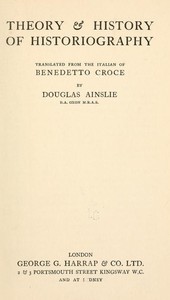
Theory & History of Historiography
Written by Benedetto Croce
Chaptra reads alongside you — AI insights, chapter breakdowns and reader discussions for every book. Join free
About this book
Reading guide
Themes, characters and key ideas in Theory & History of Historiography, written by Chaptra AI.
- about 25 hours
- advanced
- philosophical
- analytical
- intellectual
Benedetto Croce's "Theory & History of Historiography" is a seminal early 20th-century philosophical treatise that radically redefines the nature of historical understanding. It champions the idea that all history is inherently contemporary, shaped by present contexts and the historian's active interpretation rather than being a mere recounting of past facts. Croce meticulously distinguishes between 'history' as a living, interpretive act and 'chronicle' as inert, raw data, arguing that true historical truth emerges from the re-enactment of past experience within the present consciousness. The work critiques traditional positivist approaches to history, advocating for a humanistic understanding that links past experiences with current realities and encourages critical thought, ultimately asserting the inseparable unity of history and philosophy.
“All history is contemporary history.”
Key themes
- History as Contemporary Thought
- This is the central pillar of Croce's philosophy of history, arguing that historical understanding is not merely about recounting past events but is an active re-creation and interpretation of those events through the lens of present concerns, questions, and consciousness. It posits that history is always 'present history,' as it is conceived and understood from the perspective of the historian's current moment and needs.
- The Distinction Between History and Chronicle
- A foundational conceptual distinction in Croce's work, differentiating between chronicle as the raw, inert collection of facts, documents, and dates (the 'dead past') and history as the active, interpretive process that breathes life and meaning into these facts, making them relevant and comprehensible to the present. Chronicle is merely data; history is the narrative and understanding derived from that data.
- The Unity of History and Philosophy
- Croce's idealist conclusion, asserting that history, when properly understood as an act of living thought and interpretation, is inseparable from philosophy. He argues that history is not merely a collection of facts but a continuous process of self-knowledge and the development of the human spirit, making it philosophy in its concrete, empirical manifestation. Historical understanding is a form of philosophical insight into human experience.
Worth discussing
How does Croce's assertion that 'all history is contemporary history' challenge traditional notions of historical objectivity? What are the implications for historical research today?
Chapter-by-chapter breakdowns, character arcs and the full thematic analysis come with a free account.
Discussions
No one has started one yet
Questions this book opens up
No discussions yet
Be the first to start a discussion about this book!
Sign up to start the discussionReviews
No reviews yet
Be the first to review this book!