
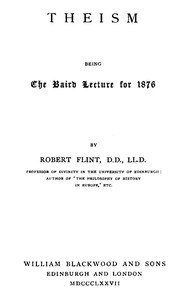
Theism; being the Baird Lecture of 1876
Written by Robert Flint
Chaptra reads alongside you — AI insights, chapter breakdowns and reader discussions for every book. Join free
About this book
Reading guide
Themes, characters and key ideas in Theism; being the Baird Lecture of 1876, written by Chaptra AI.
- about 25 hours
- advanced
- Intellectual
- Rigorous
- Philosophical
Robert Flint's "Theism" (1876) is a comprehensive philosophical treatise defending the rational validity of belief in God. As the Baird Lecture, it rigorously examines the historical and philosophical underpinnings of theism, arguing for a God who is self-existent and perfect. Flint posits that genuine religious belief must stem from knowledge and rational justification, not mere feeling, laying groundwork for various theistic proofs. The work contends that a worldview without a divine entity ultimately undermines truth, meaning, and the very foundation of human morality and thought, emphasizing the profound interconnectedness of these with the existence of God.
“Religious belief, to be truly human, must be rooted in knowledge, not mere feeling.”
Key themes
- Rational Justification of Belief
- Flint's central thesis is that belief in God is not merely a matter of subjective feeling or blind faith, but can and must be rationally defended and grounded in knowledge. He seeks to demonstrate that theism is intellectually coherent and justifiable through logical arguments and empirical observation, providing a robust counter-argument to skepticism.
- Nature of God
- Beyond merely proving God's existence, Flint delves into the attributes and characteristics of the divine being. He argues for a God who is self-existent, perfect, infinite, omnipotent, omniscient, and morally supreme, exploring how these attributes are necessitated by the proofs and what they imply for creation and human understanding.
- Critique of Anti-Theistic Theories
- A significant portion of Flint's work is dedicated to systematically refuting various anti-theistic positions prevalent in his time, including atheism, pantheism, and agnosticism. He aims to expose their logical flaws, their inability to adequately explain reality, and their perceived negative implications for human experience and reason.
Worth discussing
To what extent can the existence of God be proven through reason alone, as opposed to faith or revelation?
Chapter-by-chapter breakdowns, character arcs and the full thematic analysis come with a free account.
Discussions
No one has started one yet
Questions this book opens up
No discussions yet
Be the first to start a discussion about this book!
Sign up to start the discussionReviews
No reviews yet
Be the first to review this book!