
About this book
Reading guide
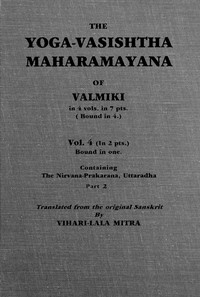
Themes, characters and key ideas in The Yoga-Vasishtha Maharamayana of Valmiki, Vol. 4 (of 4), Part 2 (of 2), written by Chaptra AI.
- about 8 hours
- advanced
- philosophical
- contemplative
- enlightening
The Yoga-Vasishtha Maharamayana, Vol. 4, Part 2, is a profound ancient Hindu philosophical text presented as a dialogue between the sage Vasishtha and Prince Rama. This segment delves deeply into the nature of reality, positing the world as an illusion (maya) born of the mind's perceptions and ignorance. Through intricate narratives and philosophical arguments, Vasishtha guides Rama towards an understanding of non-duality and the ultimate reality of Brahma, an intellectual vacuum beyond sensory grasp. It explores existential themes, consciousness, and the observer-observed relationship, aiming to lead seekers to enlightenment. The text emphasizes transcending duality and recognizing the true, unchanging Self amidst the fleeting phenomena of existence.
“The world, as perceived through the senses, is a mere illusion shaped by ignorance and the mind's perceptions.”
Key themes
- The Illusory Nature of Reality (Maya)
- This is the foundational theme, asserting that the world perceived through senses and intellect is not ultimately real but a transient, mind-created illusion. Vasishtha elaborates on how ignorance (avidya) and the mind's projections (vrittis) construct this perceived reality, akin to a dream or a mirage.
- Non-Duality (Advaita)
- This theme is the ultimate conclusion of understanding Maya. It posits that there is no fundamental separation between the individual self (Atman) and the ultimate reality (Brahman), nor between the observer and the observed. All apparent distinctions are superimposed on a singular, undifferentiated consciousness.
- The Path to Enlightenment/Liberation (Moksha)
- The ultimate aim of the Yoga-Vasishtha is to guide the seeker towards Moksha, liberation from suffering and the cycle of rebirth, through the realization of one's true, non-dual Self. This path involves inquiry (vichara), discrimination (viveka) between the real and unreal, detachment (vairagya), and spiritual practice (abhyasa).
Worth discussing
How does the concept of 'Maya' (illusion) presented in the text challenge your understanding of reality?
Chapter-by-chapter breakdowns, character arcs and the full thematic analysis come with a free account.
Discussions
No one has started one yet
Questions this book opens up
No discussions yet
Be the first to start a discussion about this book!
Sign up to start the discussionReviews
No reviews yet
Be the first to review this book!