
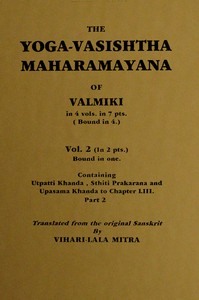
About this book
Reading guide
Themes, characters and key ideas in The Yoga-Vasishtha Maharamayana of Valmiki, Vol. 2 (of 4), Part 2 (of 2), written by Chaptra AI.
- about 8 hours
- advanced
- philosophical
- introspective
- profound
The Yoga-Vasishtha Maharamayana, Vol. 2, Part 2, continues a profound philosophical dialogue between Sage Vasishtha and Prince Rāma, delving deeply into the nature of existence and reality. This section emphasizes the mind's central role in constructing our perceived world, asserting that reality is an illusion akin to dreams or mirages. Through intricate discussions, the text systematically explores the interplay between ignorance and true knowledge, the essence of consciousness, and the cyclical journey of birth and rebirth. It serves as a comprehensive guide to understanding non-dualistic principles and achieving spiritual liberation, rooted in ancient Indian philosophical traditions.
“The world is a mere projection of the mind, just as a dream is a creation of the sleeping consciousness.”
Key themes
- The Nature of Reality and Illusion (Maya)
- This is the central theme, asserting that the phenomenal world is not ultimately real but an illusion or a mental construct. Vasishtha elaborates on how our perception of reality is shaped by the mind, likening it to dreams, mirages, or artistic representations. The world's apparent solidity is a product of ignorance (avidya), and true reality lies beyond sensory experience.
- Mind and Consciousness
- The text deeply explores the intricate relationship between the mind (manas) and ultimate consciousness (Chit/Brahman). The mind is presented as the creator and projector of the illusory world, while consciousness is the fundamental, unchanging substratum upon which all mental activity and perceived reality unfold. Understanding the mind's mechanics is crucial for transcending its limitations and realizing pure consciousness.
- Ignorance (Avidya) and Knowledge (Vidya)
- The text posits ignorance as the root cause of suffering and the perception of a separate, dualistic reality. True knowledge, or vidya, is not merely intellectual understanding but a direct realization of the non-dualistic truth—that the self is identical with ultimate consciousness and the world is illusory. The dialogues guide Rāma from the darkness of ignorance to the light of self-knowledge.
Worth discussing
How does Vasishtha's assertion that the world is a 'construct of the mind' challenge our conventional understanding of reality?
Chapter-by-chapter breakdowns, character arcs and the full thematic analysis come with a free account.
Discussions
No one has started one yet
Questions this book opens up
No discussions yet
Be the first to start a discussion about this book!
Sign up to start the discussionReviews
No reviews yet
Be the first to review this book!