
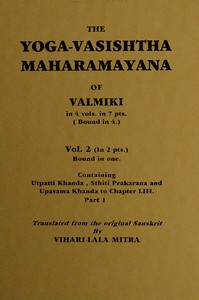
About this book
Reading guide
Themes, characters and key ideas in The Yoga-Vasishtha Maharamayana of Valmiki, Vol. 2 (of 4), Part 1 (of 2), written by Chaptra AI.
- about 15 hours
- advanced
- Philosophical
- Mystical
- Reflective
This volume of Valmiki's "The Yoga-Vasishtha Maharamayana" delves into profound philosophical questions through the narrative lens of Princess Lílá and her husband Padma. Rooted in ancient Hindu philosophy, the text explores the illusory nature of reality, the eternal essence of the soul, and the transcendental journey of human consciousness. It opens with the dramatic turmoil in Sindhu's realm, quickly shifting focus to Lílá's internal struggle as she observes Padma's impending death. Through mystical experiences and introspective discussions, Lílá grapples with misinterpretations of existence, ultimately seeking an understanding of life, death, and the fundamental unity of all being.
“The world you perceive is but a dream, a fleeting image in the vast canvas of consciousness.”
Key themes
- Reality and Illusion (Maya)
- This theme is central to the text, positing that the external, material world, with its suffering and impermanence, is not ultimately real but an ephemeral illusion (Maya). The narrative, particularly through Lílá's experiences, systematically dismantles conventional perceptions, guiding characters toward an understanding that sensory experience is a projection of consciousness.
- Nature of the Soul and Self
- The text deeply explores the concept of the soul (Atman) as distinct from the body and mind, asserting its eternal, unchanging, and divine nature. It guides characters to understand that the true 'self' is not the individual ego or physical form, but a part of the universal consciousness (Brahman), free from the cycles of birth and death.
- Life, Death, and Transcendence
- Beyond merely acknowledging life and death, the text redefines them as interconnected phases within an eternal continuum, rather than absolute beginning and end. Death is presented not as annihilation but as a transition or an illusion, a gateway to higher states of consciousness and ultimate transcendence from the cycle of rebirth (samsara).
Worth discussing
How does the text's portrayal of 'illusion' (Maya) challenge our everyday understanding of reality?
Chapter-by-chapter breakdowns, character arcs and the full thematic analysis come with a free account.
Discussions
No one has started one yet
Questions this book opens up
No discussions yet
Be the first to start a discussion about this book!
Sign up to start the discussionReviews
No reviews yet
Be the first to review this book!