
About this book
Reading guide
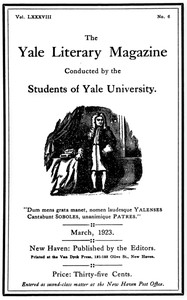
Themes, characters and key ideas in The Yale Literary Magazine (Vol. LXXXVIII, No. 6, March 1923), written by Chaptra AI.
- about 8 hours
- advanced
- reflective
- intellectual
- earnest
The Yale Literary Magazine (Vol. LXXXVIII, No. 6, March 1923) is a vital historical document, offering a unique glimpse into the intellectual and artistic landscape of Yale University during the early 20th century. This issue, a collection of student-produced essays, poetry, drama, and reviews, encapsulates the perspectives and creative endeavors of young intellectuals navigating a rapidly changing post-WWI world. It features a reflective leader on college humor and maturity by Maxwell E. Foster, a dramatic piece by Russell W. Davenport, and Foster's 'Five Sonnets,' among other diverse contributions. Collectively, the volume explores themes of identity, love, the challenges of a modern generation, and the evolving social dynamics of the era, while also fostering critical literary discourse.
“"The true measure of a Yale man's wit lies not merely in his jests, but in the wisdom gleaned from their shared laughter and the maturity born of self-reflection."”
Key themes
- Humor and Maturity in College Life
- This theme is explicitly addressed in Maxwell E. Foster's leader essay, exploring how humor functions within the collegiate environment and its relationship to intellectual and personal maturation. It likely delves into the nuances of youthful wit versus seasoned wisdom, and how shared laughter or self-deprecating humor contributes to a deeper understanding of self and community.
- Challenges of the Modern Generation
- This theme captures the anxieties, disillusionment, and aspirations of young intellectuals coming of age in the aftermath of World War I. It reflects their grappling with new social dynamics, technological advancements, and a questioning of traditional values, as they seek to forge a new path in a rapidly evolving world.
- Identity and Self-Discovery
- A core theme for young intellectuals, particularly in the post-WWI era, as individuals grappled with who they were in a rapidly changing world. This theme likely permeates the poetry and drama, exploring personal introspection, the formation of self, and the challenges of defining one's place amidst evolving social norms and cultural shifts.
Worth discussing
How does Maxwell E. Foster's leader on humor and maturity reflect the broader intellectual climate and values of Yale in 1923?
Chapter-by-chapter breakdowns, character arcs and the full thematic analysis come with a free account.
Discussions
No one has started one yet
Questions this book opens up
No discussions yet
Be the first to start a discussion about this book!
Sign up to start the discussionReviews
No reviews yet
Be the first to review this book!