
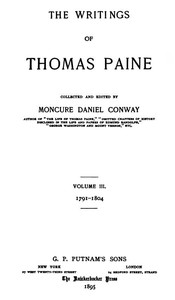
The Writings Of Thomas Paine, Volume III.: 1791-1804
Written by Thomas Paine
Chaptra reads alongside you — AI insights, chapter breakdowns and reader discussions for every book. Join free
About this book
Reading guide
Themes, characters and key ideas in The Writings Of Thomas Paine, Volume III.: 1791-1804, written by Chaptra AI.
- about 12 hours
- advanced
- revolutionary
- analytical
- polemical
The Writings of Thomas Paine, Volume III: 1791-1804, compiles a crucial selection of Thomas Paine's political discourse from the height of the French Revolution through the early years of the 19th century. This volume showcases Paine's unwavering commitment to republican ideals, his fierce critiques of monarchical systems, and his profound advocacy for universal human rights. Featuring works like his 'Republican Proclamation' and extensive correspondence, it provides direct insight into his active participation in the political upheavals of his era. Paine's articulate arguments underscore the necessity of establishing just republics founded on reason and the inherent rights of individuals, reflecting his significant influence on revolutionary thought across the Atlantic. The collection serves as a powerful testament to his enduring legacy as a champion of democracy and an enemy of tyranny.
“Government by kings is the invention of the most barbarous ages.”
Key themes
- Republicanism vs. Monarchy
- This is the central theme, with Paine relentlessly arguing for the superiority of republican forms of government based on popular sovereignty against the inherent injustices, irrationality, and burdens of hereditary monarchy. He posits that monarchy is an outdated, oppressive system that hinders human progress and individual liberty.
- Human Rights and Natural Law
- Paine champions the concept of inherent, inalienable human rights, arguing they are bestowed by nature or a creator, not by governments or monarchs. These rights form the moral foundation upon which legitimate government must be built, including the rights to liberty, equality, and self-governance.
- Revolution and Political Reform
- The volume is steeped in the spirit of revolution, reflecting the ongoing transformations in America and France. Paine not only justifies revolution as a legitimate response to tyranny but also provides a blueprint for how societies can transition from oppressive systems to more just, republican ones.
Worth discussing
How does Paine's critique of monarchy resonate or differ from modern critiques of authoritarianism?
Chapter-by-chapter breakdowns, character arcs and the full thematic analysis come with a free account.
Discussions
No one has started one yet
Questions this book opens up
No discussions yet
Be the first to start a discussion about this book!
Sign up to start the discussionReviews
No reviews yet
Be the first to review this book!