
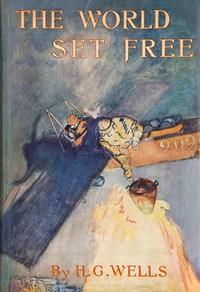
The World Set Free
Written by H. G. (Herbert George) Wells
Chaptra reads alongside you — AI insights, chapter breakdowns and reader discussions for every book. Join free
About this book
Read it with a club
Chaptra's history and war clubs — small groups reading the same books and talking as they go.


Footnotes & Firefights
History and war
- 4 members
- 4 discussions
- Active Sep 11
Military history, from grand strategy down to the deeply boring logistics that actually decided everything. This is a Chaptra house club — set up and moderated by us to get the conversation going. Open to everyone; jump in anywhere.
Read The World Set Free alongside people who are reading it too.
Also here: Empire, Reconsidered
Chaptra Prime — paid clubs, every club feature, and unlimited reading support, for $5 a month or $60 once.
See PrimeReading guide
Themes, characters and key ideas in The World Set Free, written by Chaptra AI.
- about 8 hours
- advanced
- Prophetic
- Didactic
- Somber
H.G. Wells' "The World Set Free," published in 1914, is a profoundly prophetic science fiction novel that envisions a devastating global conflict fought with "atomic bombs" in the mid-20th century. This catastrophic war, which unleashes perpetual destruction, forces humanity to confront its self-destructive tendencies and leads to the radical restructuring of global society. From the ashes of nationalistic warfare, a benevolent, technocratic World State emerges, abolishing national sovereignty and ushering in a new era of peace, scientific progress, and universal cooperation. The narrative, part future history and part philosophical treatise, explores the imperative of social and political evolution to avert total annihilation and achieve a utopian future.
“The history of mankind is the history of ideas.”
Key themes
- The Abolition of War and the Pursuit of Peace
- This is the central theme, exploring how the catastrophic "atomic war" ultimately renders traditional warfare obsolete and forces humanity to embrace global cooperation. Wells argues that the sheer destructiveness of advanced weaponry necessitates a permanent end to conflict, leading to the establishment of the World State as the only viable path to survival and enduring peace.
- Scientific Progress and Responsibility
- This theme examines the double-edged sword of scientific advancement. The discovery of atomic energy leads to unprecedented destruction when weaponized, but also provides the means for a utopian future through its peaceful applications. Wells questions humanity's capacity to responsibly manage immensely powerful technologies and suggests that ethical frameworks must evolve alongside scientific capabilities.
- The Necessity of World Government and Global Unity
- Wells posits that national sovereignty is an outdated, dangerous, and ultimately self-destructive concept in an age of advanced weaponry. He argues that only a unified global government can prevent humanity from annihilating itself and ensure its long-term survival and prosperity. The World State is presented as the inevitable and necessary evolution of political organization, driven by rational thought and a collective will to survive.
Worth discussing
How accurate was Wells's prophecy of atomic warfare and its societal impact? What did he get right, and what did he miss?
Chapter-by-chapter breakdowns, character arcs and the full thematic analysis come with a free account.
Discussions
No one has started one yet
Questions this book opens up
No discussions yet
Be the first to start a discussion about this book!
Sign up to start the discussionReviews
No reviews yet
Be the first to review this book!