
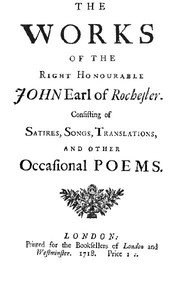
The Works of the Right Honourable John, Earl of Rochester: Consisting of Satires, Songs, Translations, and other Occasional Poems
Written by John Wilmot Rochester
Chaptra reads alongside you — AI insights, chapter breakdowns and reader discussions for every book. Join free
About this book
Read it with a club
Chaptra's poetry and plays clubs — small groups reading the same books and talking as they go.


Shakespeare Out Loud
Poetry and plays
- 4 members
- 4 discussions
- Active Sep 11
Plays are scripts, not novels. We read them aloud, in parts, and it changes everything. This is a Chaptra house club — set up and moderated by us to get the conversation going. Open to everyone; jump in anywhere.
Read The Works of the Right Honourable John, Earl of Rochester: Consisting of Satires, Songs, Translations, and other Occasional Poems alongside people who are reading it too.
Chaptra Prime — paid clubs, every club feature, and unlimited reading support, for $5 a month or $60 once.
See PrimeReading guide
Themes, characters and key ideas in The Works of the Right Honourable John, Earl of Rochester: Consisting of Satires, Songs, Translations, and other Occasional Poems, written by Chaptra AI.
- about 12 hours
- advanced
- satirical
- cynical
- humorous
John Wilmot, Earl of Rochester's collected 'Works' is a seminal compilation of Restoration-era poetry, showcasing his profound wit, biting satire, and philosophical cynicism. Through a diverse array of satires, songs, and occasional verses, Rochester dissects the follies of mankind, particularly focusing on societal hypocrisy, the complexities of love and lust, and the inherent contradictions of human nature. The collection is characterized by its incisive, often bawdy, commentary on social norms, religion, and morality, challenging conventional wisdom with both humor and intellectual rigor. It serves as a vivid literary portrait of a libertine age, offering enduring insights into the darker, more absurd aspects of human existence and relationships.
“Were I (who to my cost already am / One of those strange prodigious creatures Man) / A spirit free, to choose for my own share / What sort of flesh and blood I pleased to wear, / I'd be a dog, a monkey, or a bear, / Or anything but that vain animal / Who thinks himself the image of the All-wise God.”
Key themes
- Human Nature and Folly
- Rochester relentlessly critiques human nature, arguing that humans are inherently flawed, driven by base desires, and prone to irrationality. He often posits that humans are no better, and frequently worse, than animals, due to their capacity for self-deception and hypocrisy. This theme is most famously explored in 'A Satire Against Mankind,' where he systematically dismantles the notion of human reason as a guiding force, instead portraying it as a tool for rationalizing vice.
- Love, Lust, and Disillusionment
- This theme explores the complex interplay between genuine affection, physical desire, and the inevitable disappointment that often follows. Rochester frequently portrays love as fleeting, easily corrupted by lust, self-interest, or societal pressures. His poems often depict the pain of betrayal, the emptiness of superficial relationships, and the cynical view that true, lasting love is an illusion, if not a delusion.
- Societal Hypocrisy and Corruption
- Rochester is a master at exposing the moral bankruptcy and pretense within society, particularly among the aristocracy and religious figures. He critiques the superficiality of court life, the false piety of the clergy, and the general moral decay he observes. His satire often targets those who outwardly profess virtue while secretly indulging in vice, highlighting the chasm between public appearance and private reality.
Worth discussing
How does Rochester's 'A Satire Against Mankind' challenge prevailing notions of human superiority and rationality? Is his critique still relevant today?
Chapter-by-chapter breakdowns, character arcs and the full thematic analysis come with a free account.
Discussions
No one has started one yet
Questions this book opens up
No discussions yet
Be the first to start a discussion about this book!
Sign up to start the discussionReviews
No reviews yet
Be the first to review this book!